This chapter deals with some basics regarding number theory. It in particular focuses on the natural/whole numbers, but the concepts can be applied to any Field.
Prerequisites
We assume that the concepts of , addition, multiplication, negation, associativity, commutativity, distributivity, and are clear.
4.2 Divisors and Division
4.1 Divides
We say that divides for any integers (denoted ) if .
is a divisor (de: Teiler) of , a multiple (de: Vielfaches) of and the quotient (de: Quotient).Every non-zero integer is a divisor of . Moreover and are divisors of every integer.
We define a prime as .
4.1 Euclidean Division
For all integers and there exist unique integers and satisfying
is called the remainder (de: Rest).
4.2 Greatest Common Divisor
For integers and (not both ), an integer is called a greatest common divisor of and if divides both and and if every common divisor of and divides , i.e. if
4.3 GCD
For (not both 0), one denotes the unique postive greatest common divisor by and usually calls it the greatest common divisor. If , then and are called relatively prime.
Proof if and are coprime.
This is an important result for the exam:
Which is the same as saying such that . Since and , we have:
Since , by Bézout’s identity:
Now we can write:
Thus .
4.2 GCD relations
For any integers and we have
This implies the necessary step for Euclid’s algorithm
4.4 Ideals
For , the ideal generated by and , denoted , is the set
Similarly, for a single integer we have
4.3 All ideals can be generated by a single integer
For there exists such that .
This implies that every ideal can be generated by a single integer.
4.4 GCD
Let (not both 0). If , then is a greatest common divisor of and .
4.5 GCD result of ideal
For (not both ), the exist such that
This is Bézout’s identity.
There is an algorithm (Euclidean algorithm) which can be used to find the values of and for this decomposition.
It works by computing the euclidean decomposition and replacing by in , rince and repeat until you arrive at . Then you can use back propagation to find the values for the equation .
Knowing this algorithm is necessary for the exam!
Walk-through:
- Gleichungen der Reste:
- Rückwärtssubstitution:
Ergebnis: und
4.5 Least common multiple
The least common multiple of two positive integers and , denoted , is the common multiple of and which divides every common multiple of and , i.e.
4.3 Primes
4.6 Primes
A positive integer is called prime if the only positive divisors of are and itself. An integer greater than that is not prime is called composite.
4.6 Fundamental theorem of arithmetic
Every positive integer can be written uniquely (up to the order in which factors are listed) as the product of primes.
We need to state this theorem when decomposing any integer into it’s prime factors!
4.7 Prime divides one in product
If is a prime which divides he product of some integers , then divides one of them, i.e. for some
We can now express the and in this form. Let and be
Then
and
We can also see that as .
4.9 Infinity of primes
There are infinitely many primes.
4.10 Prime density
Gaps between primes can be arbitrarily large, i.e. for every , there exists such that the set contains no prime.
4.7 Prime counting function
The prime counting function is defined as follows: For any real is the number of primes .
4.11 Prime counting function limit
To test whether a number is prime, we have to test every smaller integer which could be a divisor, there is one shortcut however.
4.12 Prime divisors
Every composite integer has a prime divisor .
Congruences and Modulo Arithmetic
4.8 Congruence
For with , we say that is congruent to modulo if divides . We write or simply , i.e.,
We define the function as the smallest positive for which .
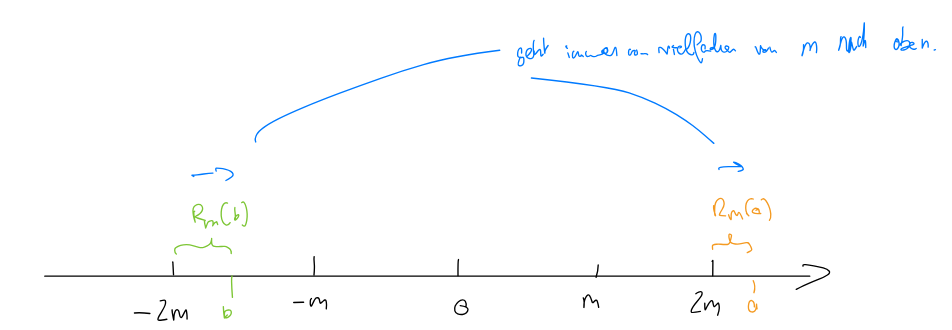
4.13 Modulo Equivalence Relation
For any , is an equivalence relation on .
4.14 Modular arithmetic
If and then
Simplifying calculations
4.15 Modular reduction of a multivariate polynomial
Let be a multi-variate polynomial in variables with integer coefficients, and let . If for , then
We are often interested in only the remainder of an integer calculation. We want the result to be bounded below the we are moduloing against.
We can use the fact that is an equivalence relation and since there are equivalence classes namely . Each class has a smallest, natural representative in the set .
4.16
For any with ,
Together these two properties imply that:
4.17 Polynomial reduction
Let be a multi-variate polynomial in variables with integer coefficients, and let . Then
Example This is what helps us reduce things like .
Diophantine Equations
We can show that certain equations don’t have solutions in using modular arithmetic.
We will show this on the example:
- is always even (show this using case distinction from )
- is always odd (again by case distinction).
Try using and at first, as this will usually work.
Multiplicative inverses
4.18 Modular Inverse
The congruence equation
has a solution if and only if . The solution is unique.
Note that this only works for as otherwise the rest would always be something and never 1.
4.9 Multiplicative inverse
If , the unique solution to the congruence equation is called the multiplicative inverse of a modulo . One also uses the notation or .
Chinese Remainder Theorem
4.19 The Chinese Remainder Theorem
Let be pairwise relatively prime integers and let . For every list with for , the system of congruence equations
for has a unique solution satisfying .
Warum funktioniert die CRT-Konstruktion?
Die Summe:
Betrachte für ein festes :
- Für : ist durch teilbar, also . Somit
. - Für : , also .
Ergebnis: , nur der -te bleibt als . Also erfüllt jede Kongruenz!
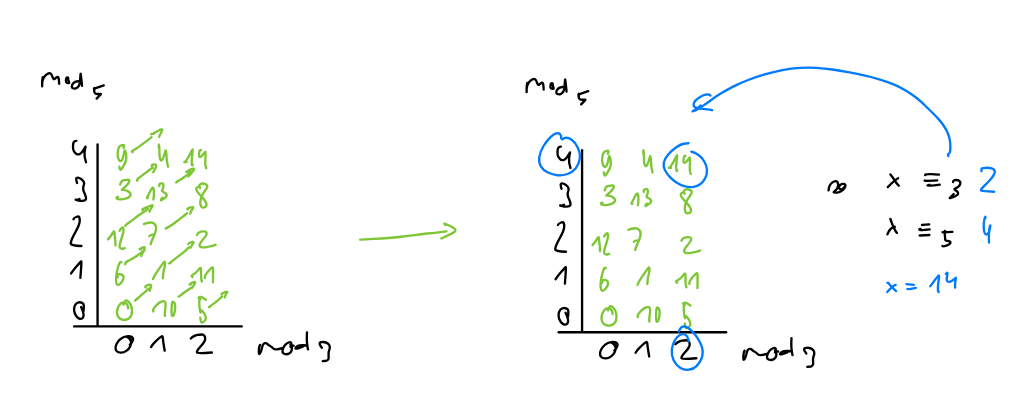
We can also see the CRT as saying that for all pairwise relatively prime, there exists a unique solution mod for the equations.
Or seen still otherwise, there is a unique bijective mapping from the numbers to each modulo .
This mapping can be made visible in such a table:
Technique
The Chinese Remainder Theorem is very useful to make big operations inside an easier to process.
Example: Computing
can be decomposed into two sub-remainders. As , we can use:
and
Thus and . Then we have and , thus .
General Technique When the final remainders are not both simple values like 1 and 1, you need to find such that:
- where .
Solution: Use the formula where (for the specific case of a decomposition into two formulas).
Brief Example: If and , then:
- Find (since )
- Find (since )
- Calculate:
- Therefore
Diffie-Hellman Key-Exchange
The Diffie-Hellman key exchange protocol is used to establish a shared key over an insecure channel.
Because modular exponentiation is hard to invert (we basically need to try all possible numbers), we can safely share the and know that an attacker would never be able to figure out the from that.
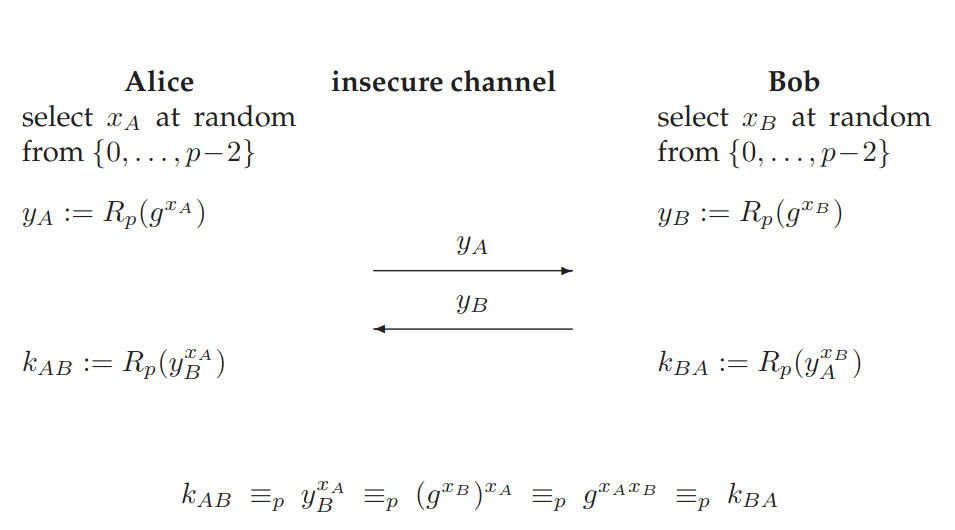
Example Calculation: We use and , which are public.
- In private Alice and Bob each select a random element from that is not (i.e. the inverse).
- Alice , Bob
- Then
- Then
- The secret key is then . Thus both are left with the same key.
The attacker Eve would have to solve the Discrete Logarithm problem to recover each participants choice of key.
Exercises
Reducing expressions like
As , we can reduce the exponent modulo (see Lagrange’s theorem in chapter 5). Thus .
For this to work however, we need the number and the order of the group (modulo remainder) to be coprime, i.e. .