The All-Pairs Shortest Path problem addresses the fact that previously we only computed the shortest paths from a start vertex to all others.
The naive way to do this would be to run our known algorithms times, once for each possible source vertex:
| Cost Function | Algorithm | Runtime |
|---|---|---|
| BFS repeated | ||
| Dijkstra’s repeated | ||
| Bellman-Ford repeated | ||
| Note that if we have for a fully connected graph, BF gives . |
Floyd-Warshall
Restrictions: No negative Cycles
Runtime:
Floyd-Warshall utilises dynamic programming to calculate the shortest paths more effectively. Once the DP-Table has been computed, we can query it for efficient lookups.
Recurrence
Consider a graph with vertices .
Our subproblem is: ” shortest path from to passing only vertices with index “. (This gives us a 3D DP table.)
There are three options in the recurrence here:
- The path uses the vertex as it’s shorter:
- The path uses vertex exactly once:
- The path uses more often (only worth it if is in a negative cycle thus we ignore it)
Our base case is :
- If :
- If :
- If :
- Otherwise
Implementation (Bottom-Up)
We can optimise the recurrence not to store the values in a 3D, but a 2D array only, by keeping only the last values.
The best way to store the edges and their costs is in a Adjacency Matrix, as this allows the fastest lookup, which is the only needed operation here.
def FloydWarshall(V, E, c):
    n = len(V)
    d = [[float('inf')] * n for _ in range(n)]  # Initialize distances to infinity

    # Base Cases: Distance to self is 0, direct edge costs
    for u in V:
        d[u-1][u-1] = 0
        for v in V:
            if (u, v) in E:
                d[u-1][v-1] = c((u, v))

    # Main Dynamic Programming Loop
    for k in range(1, n + 1):         # Intermediate vertices allowed (1 to n)
        for i in range(1, n + 1):     # Source vertex
            for j in range(1, n + 1): # Destination vertex
                d[i-1][j-1] = min(d[i-1][j-1], d[i-1][k-1] + d[k-1][j-1])

    return d
Important: Use a value like 10000 instead of Integer.MAX_VALUE in Java, as you get overflows otherwise.
We can also read of the shortest paths by keeping a pred array in which we store the vertex k that lead to the update of the value. Then we can recursively reconstruct the path.
Runtime
We can read off the runtime from the 3 for loops very easily. Floyd-Warshall runs in .
Negative Cycles
Floyd-Warshall detects negative cycles in a similar way to Bellman-Ford.
Negative Cycles with Floyd-Warshall
There exists a negative cycle
In words: If there exists a path from a vertex to itself with negative weight (passing through any other vertex, i.e. after the th iteration of the outer loop), then there exists a negative cycle that contains this vertex.
We can thus check for the existence of a negative cycle by running the following check:
# Negative Cycle Detection
for v in V:
	if d[v-1][v-1] < 0:
		return "Negative Cycle Detected"
Proof: (by contradiction)
- Assume a negative cycle exists
- Decompose it into a path from start-vertex to and back, where has the highest index all vertices in the cycle. This gives and .
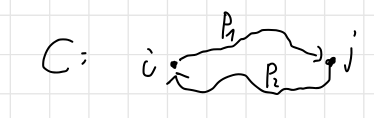
- We can now use the subproblems (true by optimality principle of DP):
- Thus . But because , there will be one diagonal entry .
Note: If there exists a negative cycle, but it’s not reachable from and any vertex in the cycle doesn’t reach , we can ignore it and the distance will still be correct.
Johnson’s Algorithm
Runtime: (exactly as fast as times Dijkstra’s, but runs on negatives)
Requirements: Negative edges allowed, no negative cycles
Johnson’s increases the weight of all edges to in order to allow Dijkstra’s to run on the graph.
It does this by assigning a height to each vertex. The new cost is then .
This means that for a path the cost the costs cancel out in pairs: gives . This is called a telescoping sum.
Naive Approach
Why adding a constant to each edge (equal to the lowest negative edge as to make it 0) doesn’t work: A longer path (more edges) would get increased in cost more than a shorter. This is not what we want, we want the ordering to stay the same. Thus we need the cost to only depend on the start- and end-vertex (not on which path was taken).
How to determine the heights
We need the heights to be chosen such that the edge weights are all which is a seemingly hard problem.
Note that the system has no solution if there are negative weight cycles. These will also be reported during the B-F run and then we can abort computation.
The solution is to add a new vertex which has a directed edge of cost 0 to all vertices in the graph:
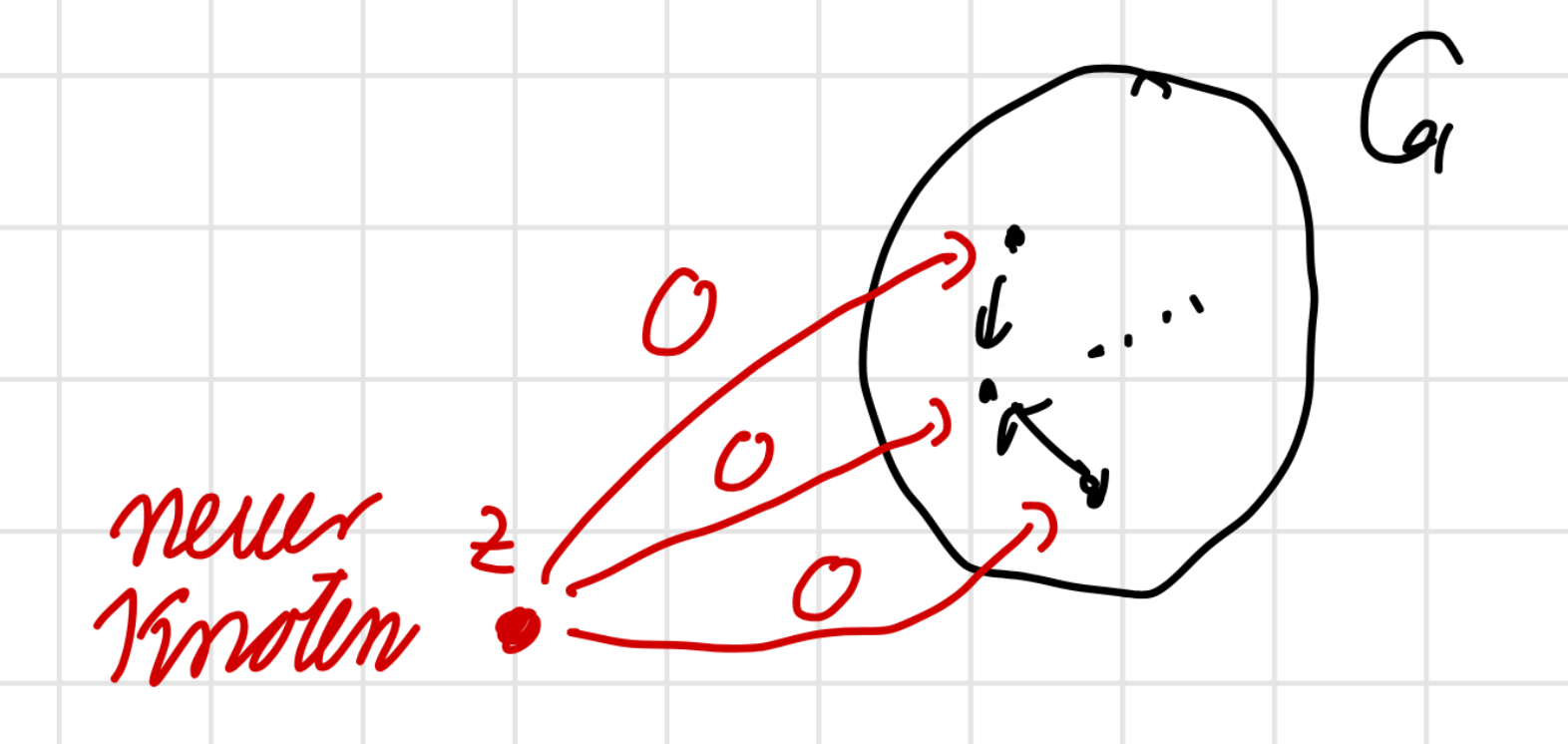
We then run B-F on the graph starting from and the height of each vertex is equal to the . We know by the triangle inequality and the definition of shortest path:
which then gives us by rearranging, which is exactly what we want.
We can now run Dijkstra’s.
| Step | Runtime | Description |
|---|---|---|
| 1. Augment Graph | Add a new vertex and connect it to all existing vertices with zero-weight edges. | |
| 2. Compute Heights | Run Bellman-Ford from z to calculate the height function (shortest distance from to ). Detect negative cycles. If a negative cycle is found, report it and terminate. | |
| 3. Reweight Edges | Compute reweighted edge costs for all edges . | |
| 4. Run Dijkstra’s | Run Dijkstra’s algorithm from each vertex in the reweighted graph to compute all-pairs shortest paths. | |
| 5. Undo Edge-Weights | Convert the distances back to the original weights using: |
The runtime is dominated by step 2. and 4., but as , we get just Dijkstra’s runtime.
This may sound surprising, but the higher overall cost allows us to run pre-computation steps for “free”.
When to use F-W, when Johnson’s
Dense Graphs: (, fully connected for example). Floyd-Warshall is more efficient here as the of Johnson’s is actually and thus more expensive.
Sparse Graphs: (Trees for example) Here Johnson’s shines.