TODO:
- Can return subtype of overriden function’s return type
Inheritance
We can create a subclass of another using the extends syntax.
Multiple Inheritance
Note that a class cannot inherit from multiple super-classes (this is where interfaces come in)!
public class Lorenz extends Students {
	@Override
	public void someMethod() {
		...
		super.someMethod(); // Can call super's implementation of this
	}
}
We can then override the methods defined in the parent class. Note that the @Override decorator is optional.
Note that not all methods can be over-riden. The following cannot be over-riden:
staticfinalprivateare not inherited eitherconstructors
Super Attribute
The subclass can access it’s parents attributes and methods through the super keyword.
Chained
superYou cannot use
super.super.xxx, norx.super.xxxto access super methods or attributes. This gives a compile error.
Constructors
Constructors are not inherited by subclasses.
When writing a constructor for B extends A we get an automatic call to super() inserted. We can also make this call explicit.
No default constructor
If
Ahas no default (or parameter-less) constructor defined, ourpublic B()must have an explicit call tosuper(10, "test")with the required arguments.
This means that if A has no default or parameter-less constructor, we must define one explicitly for B.
Visibility
Class visibility:
publicvisible everywheredefaultonly in the package, also meansclass Adoes not necessarily need to be in the fileA.javaprivateinner classes: only visible to the outer class.
Attribute visibility of parent:
privateattributes of the parent cannot be accesses from any children- Note that inherited methods (not over-riden) can access private attributes
- To fix this we can use getters and setters
protectedare visible only to class and subclasses.
Changing visibility of methods:
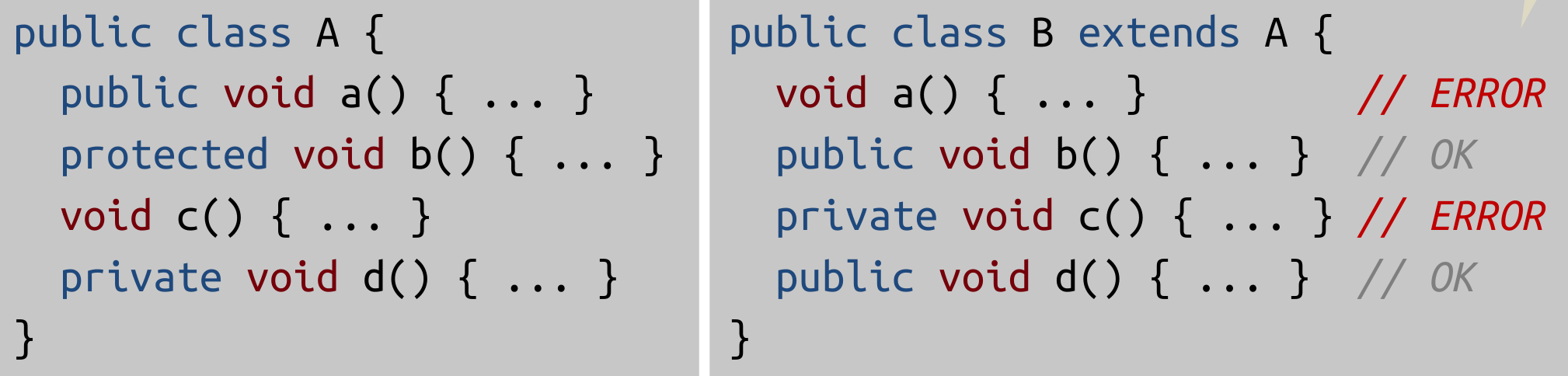
We cannot reduce the visibility, only make it more visible!
Polymorphism
Static vs. Dynamic Type
The static type is the type that the compiler sees as assigned to the variable. The dynamic type is the runtime type. The static type can be changed by casting, the dynamic type by changing the reference to an instance of a different subtype.
// Animal is static type
Animal a = new Dog();
// Dog is dynamic type
Subtype
The dynamic type is always a subtype of the static type.
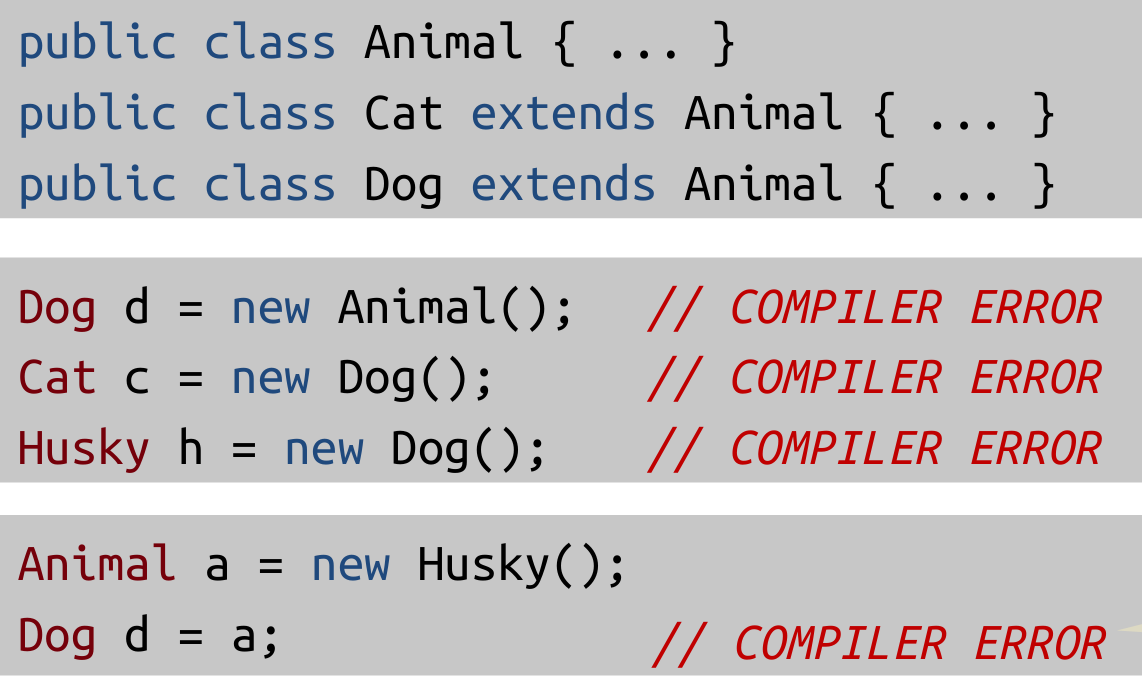
Instance Of
instanceof tests whether an instance has a same dynamic type or if it implements an interface.
It also returns true if an object is a subclass of the given type: dog instanceof Animal returns true, as does dog instanceof Dog.
instanceof never throws an exception, just compile errors.
Note that:
obj = nullthenobj instanceof Stringreturns false not an exception
Compile Errors:
- Primitive types cannot be used with Instance Of
- Cannot check for generics, type erasure prevents this
t instanceof List<Stringwill not compile as it cannot check the parametrised type
- Comparing siblings:
Animal -> DogandAnimal -> Cat.- Check for
animal instanceof Dog/Catallowed, butdog = new Dog(); dog instanceof Catthrows compile error.
- Interface checks for
finalclasses: A final class cannot implement an interface in a subclass, thus errorAnimal a = getanimal()could get aDogwhich mightimplement Listthusa instanceof Listis not a compile error.
Casting
Upcasting is always done automatically and not needed.
We can use typecasting (B) a for explicit downcasting. This will change the static type of a.
This will lead to runtime errors if a is not of type or a subtype of B.
Compile Errors:
Cat c = new Cat(); Dog d = (Dog) c;Casting Static typeCattoDogas they’re siblings.Cat c = (Dog) d: Assigning static type of sibling or super-type to sub-type
Runtime Errors: Animal dog = new Dog();
(Husky) dog;: Casting further down than dynamic type(Cat) dog;: Casting into sibling type
Edge Cases
Null is always castable, Animal cat = null; (Cat) cat; is allowed.
We can upcast an array which will then lead to runtime errors.
Dog[] dogs = new Dog[5];
Animal[] animals = dogs; // Allowed! (upcasting)
animals[0] = new Cat(); // Compiles but ArrayStoreException at runtime!
Type Erasure leads to a warning, but not error here:
List<Dog> dogs = new ArrayList<>();
List<Animal> animals = (List<Animal>) dogs; // Unchecked cast warning
Interface Casting
Interface casting can only throw a runtime error, except if the class is final. This is because the compiler assumes a subtype could implement the interface.
Attributes
The compiler uses the static type of the reference to find which attribute to return. So for an A a = new B() when calling a.test we get A’s test attribute.
If the static type does not define that property, we can’t access it unless we explicitly cast it.
Edge Cases
If we don’t shadow an attribute in a subtype, but instead override the parents attribute with this.x, it changes the parent’s attribute as well.
class A {
    public int x = 5;

    public void fct1() {
        System.out.println(this.x);
    }
}

class B extends A {
    public B() {
        super.x = 10;
    }
    public B(int a) {
        super.x = a;
    }
}

A a1 = new B(1);
A a2 = new B(12); // As these are different instances, their attributes are separate
B b1 = new B(1);
B b2 = new B(12);
a1.fct1(); // 1 -> Even though static type is A
a2.fct1(); // 12 -> Different output as a2's instance of A has 12
b1.fct1(); // 1 -> same here, even though it dynamic dispatches
b2.fct1(); // 12
Methods
Subtype specific
Static Type Methods
The static type decides which methods can be called on an object. If the static type doesn’t implement it, we can’t call it, even if the dynamic type defines it.
Example

We need to type cast first before using the dynamic type specific methods. We can do this explicitly or anonymously:
Animal a = new Cat();
Cat c = (Cat) a; c.meow();

((Cat) a).meow(); // Anonymous cast
Private Methods
Private methods are not inherited from the superclass and cannot be called (same as for private attributes).
Overriden methods
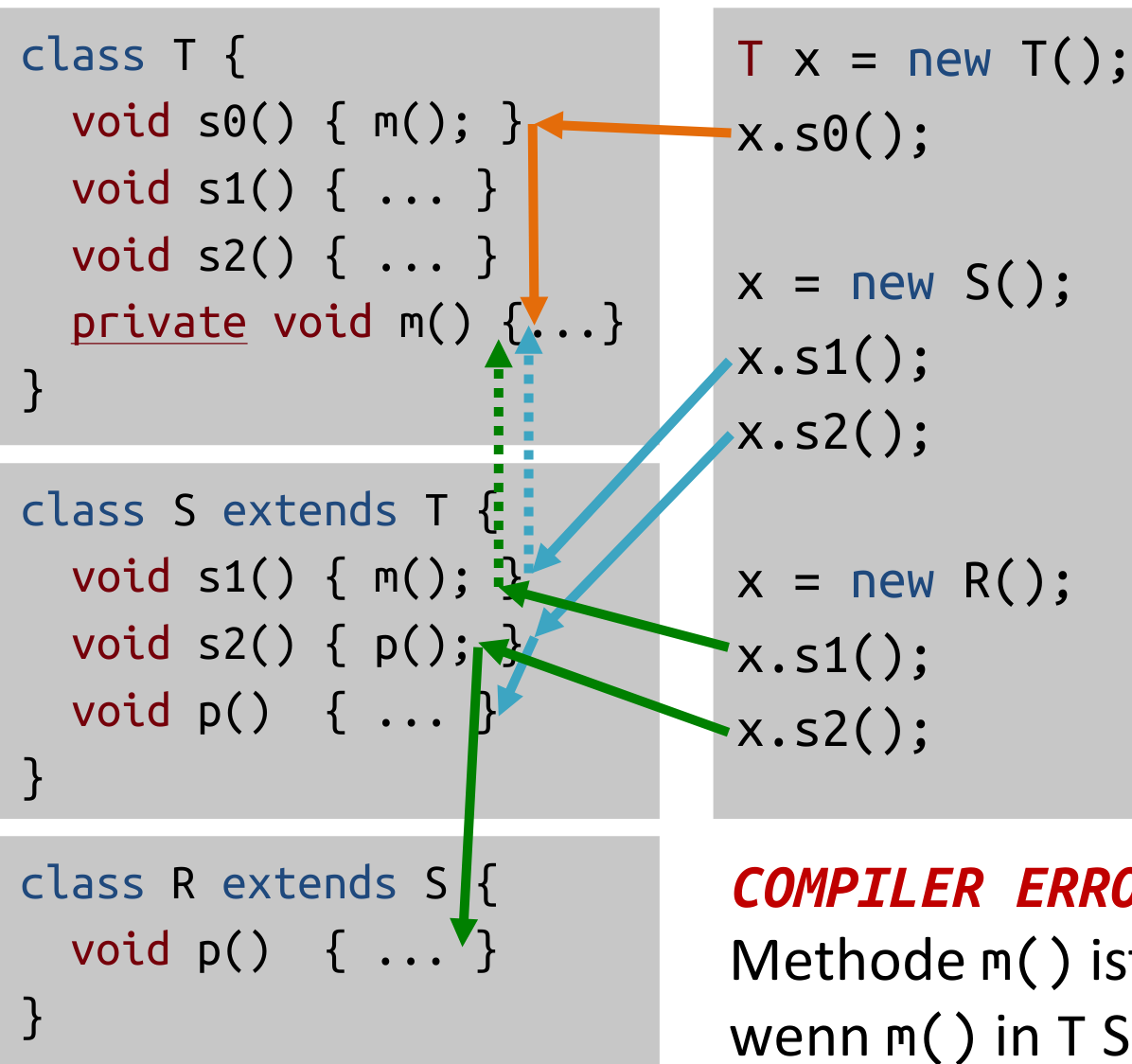
For methods which the dynamic type overrides, Java uses dynamic dispatch calls the method of the dynamic type.
Dynamic Dispatch
Dynamic dispatch uses the actual dynamic type to see which methods to call. In the following example, even though S also defines a p() method, P.r() is called, as the dynamic type of x is R in the last example.
This is because the p(); call is an implicit this.p(); where this is of instance R.
Exceptions
Static type
private,staticandfinalmethods are selected by the static type.
Attributes in Dynamic Dispatch
When a function is called in dynamic dispatch, the attributes of the type in which the actual function is executed will be used. In the following example, the attribute data of S is used as the method s2() of S is called.
class T {
    int data = 50;
    public void s2() { System.out.println("T " + data); }
}

class S extends T {
    int data = 100;
    public void s2() { System.out.println(this.data); }
}

class R extends S {
    int data = 200;
}

T r = new R();
r.s2(); // Prints "100"
Object Type
Any type is a subtype of the Object type. The object type defines the methods:
.equals(Object o).toString()- a few more…
If we try to call any other methods on an object of static type Object, this will lead to a compile error as the symbol isn’t defined.
To compare objects, we should override the .equals() method.
class Rationals {
	public boolean equals(Object o) {
		// Should check with instance of to make sure no runtime error occurs
		Rational r = (Rational) o; // Otherwise we can't access .n and .d
		return r.d * this.n == r.n * this.d;
	}
}
Shadowing
Attributes cannot be over-riden.
Shadowing happens if a subclass hides the attribute of it’s superclass by defining an attribute that is already defined on the parent:

A a = new A();
a.x = 6; // OK
a.x = true; // Compile error, type mismatch

A a = new B();
a.x = 6; // OK
a.x = true; // Compile error, type mismatch because static type is used

B b = new B();
b.x = 6; // Type Error
b.x = true; // OK!
We can access the parent’s attribute by casting the static type to it’s parent: ((A) b).x is 6.
Final Attribute
- primitive types
final int pi = 3: immutable so nopi = 4→ Compile error - Reference types
final Cat c = new Cat()cannot change the pointer, but the class attributes are mutable - classes
final class Catmeans no extending the class - methods
final public intmeans no overriding in subclasses
Abstract Classes
Abstract Classes cannot be instantiated. They are used to define some shared behaviour (where an Interface could only define the methods to implement) and already actually implement that behaviour.
They can be used as a static type AbstractClassCat cat = new RealCat() but the dynamic type is always a subtype.
Trying to create a new AbstractCat() fails with a compile error.