3.2 Gauss Elimination
Gauss Elimination is Gauss-Jordan without the multiplication.
Row Exchanges
Even after using row-exchanges, the solutions are the exact same. We don’t need to swap around the entries of our solutions.
3.2.3 Row Operations
3.2 Row Operations don't change solutions
Let be an matrix and an invertible matrix. Then the two systems and have the same solutions .
This justifies why we can use Gauss-Elimination with back-substitution to find solutions to our original LSE.
Even though our matrix changes, we only change it in ways that preserve the original solution space.
3.3 & 3.4 Invariance of Independence and Rowspace and Nullspace
For a matrix and an invertible matrix:
- (nullspace is the same)
- (rowspace is the same)
- has linearly independent columns if and only if has linearly independent columns.
Note that the column space (and thus also ) is not preserved: . The rowspace is the same because we take linear operations on the rows (we add/substract) them.
| Subspace | Preserved? |
|---|---|
| ✓ | |
| ✓ | |
| ✗ | |
| ✗ |
Example after RREF is which spans a completely different line.
and do however have:
- the independent columns at the same indices
- thus the same rank
3.2.4 Success and failure
3.8 Success of Gauss-Elimination
Let a system of linear equations in variables. If has linearly independent columns, then Gauss elimination succeeds and back-substitution finds the unique solution.
If has linearly dependent columns, Gauss elimination fails.
3.2.5 Runtime
Runtimes:
- Gauss Elimination:
- Back Substitution:
Gauss Elimination with Back-sub:
Computing the inverse:
3.3 Gauss-Jordan Elimination
G-J elimination works in the general case.
3.3.1 Reduced Row Echelon Form
3.13 RREF
is in if :
- For every , column of is the standard unit vector
- All entries “below the staircase” are .
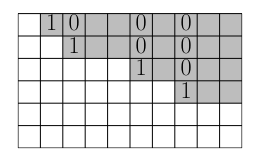
3.14 Independent columns of RREF
A matrix in has independent columns and therefore rank .
Here the are the indices of the independent columns. Example: The identity matrix is in .
3.3.2 Direct Solution
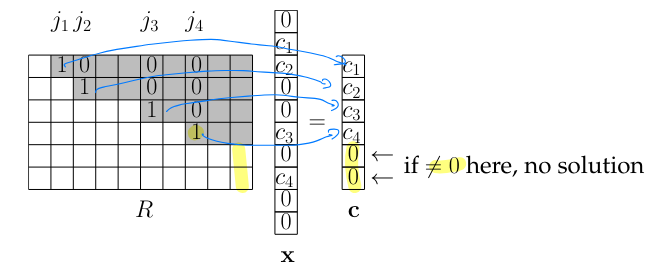
3.3.3 Elimination
We proceed as in Gauss elimination using row operations to transform into with the same solutions where in RREF form.
In contrast to Gauss elimination, we can use row division.
Runtime is
3.3.4 Standard Form and CR decomposition
3.17 Output of G-J elimination
Let be an matrix and let be the output of G-J with input where is the identity matrix.
Then is invertible, and is in .
Warning! When we want to find the inverse of , we cannot use row exchanges, as we otherwise get a different .
3.18 Uniqueness and CR
The unique matrix resulting from G-J on has the following properties
- for some invertible
- is in RREF
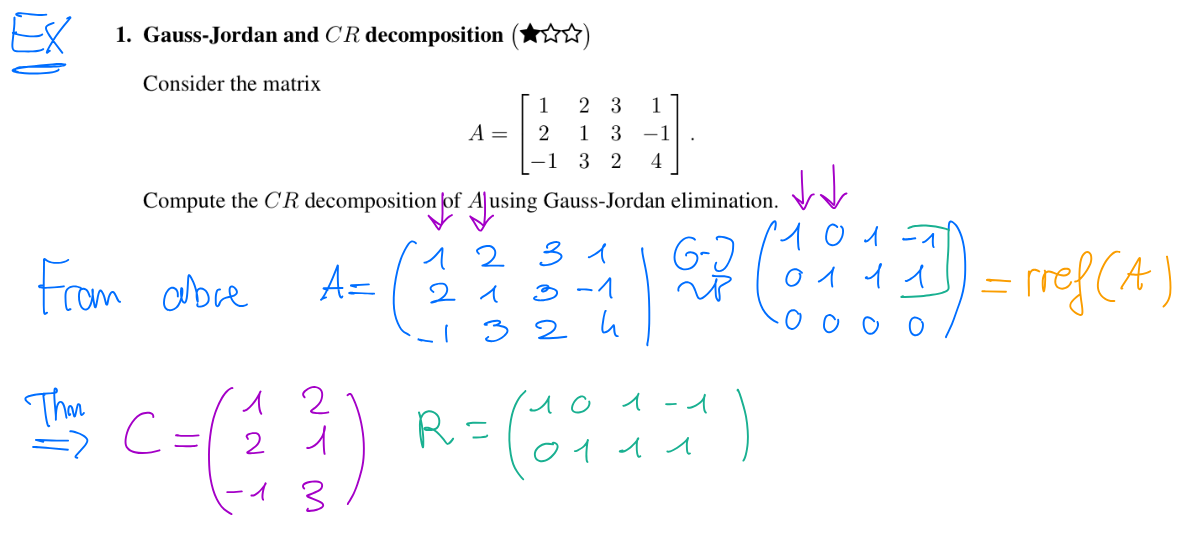
Technique: Find CR from RREF:
For result of RREF on , in where .
- This is the from the CR decomposition (non-zero rows).
- And is the submatrix taking only (independent columns).
3.3.5 Computing inverse matrices
3.19 Finding the inverse of
To find the inverse of a matrix, we can use G-J on and then get . If is invertible, and since , is the inverse of .
Note that is invertible if and only if in this case (by theorem 3.19).
3.3.6 Solving
We can then solve an using RREF on and solving the equations using back substitution.