CR Decomposition
CR decomposition
A matrix of rank can be written as the matrix-matrix product where is the submatrix containing the independent columns and the unique matrix.
You can see why this works intuitively. The result of the multiplication is a matrix in . Each column of represents the number of times we take each independent column to get the dependent ones.
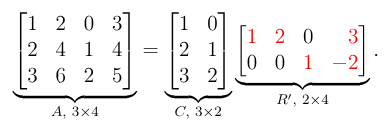
You can see that in the columns of the independent vectors, is such that the linear combination only contains the vector itself, once. The dependant columns are a combination of the independent ones (see column 2 being 2 times column 1, thus having (2, 0) as it’s second column.
Note that the C in CR’ decomposition does not need to be a column vector, it can have any width, depending on how many independent columns A has.
Invertible and Inverse Matrices
By applying the inverse matrix, you can undo any matrix transformations, as long as this matrix exists.
If the matrix in is not square, the transformation is not bijective and thus not reversible.
Wide Matrix transformations are not injective
Let be a matrix transformation and . Then is not injective. This holds because a transformation from more dimensions into less loses information, so two inputs map to the same output (by the pigeonhole principle).
Tall Matrix transformations are not injective
Let be a matrix transformation and . Then is not surjective. This holds because a transformation from less dimensions into more doesn’t map to all outputs, so you can’t reverse all of them.
Now let’s look at inversible, square-matrix linear transformations.
The inverse of a bijective linear transformation is also a linear transformation
Let be a bijective linear matrix transformation. Then is also a linear transformation.
There are three equivalent statements about matrix transformations:
Equivalences
- (i) is bijective.
- (ii) There is an matrix B such that .
- (iii) The columns of are linearly independant.
The third one can be derived from the fact that if , there is only a single such that . It is also intuitively clear that if not all columns where linearly independent, we’d actually have a tall linear transformation and would be losing information.
Definitions and Properties of Inversible Matrices
Invertible and singular matrix
Let . is invertible if there is a matrix such that (only works if has linearly independent columns). Otherwise, is called singular.
is invertible iff (the following equivalent conditions are true):
The inverse matrix is unique and can be denoted .
LEMMA
, invertible matrices . Then is also invertible and
LEMMA
Let be an invertible matrix. Then the transpose is also invertible and: $$ (A^T)^{-1} = (A^-1)^T.