2. Verilog
a)
- a “two-bit” flip-flop does not exist. It’s just two flip-flops.
- do not forget to state “active-low as the code resets if the reset signal is low”
b)
Sequential circuit “as all the left-hand side signals are not assigned in every possible condition”. For ex, data_out[0] not assigned foor mask = 0.
c)
State “NOT syntactically correct”
- if something has multtiple assigns, it has multiple drivers, which is wrong.
3. FSMs
b), c)
DO NOT forget to give an equation for O[0] = ... the output!!!!
→ make sure to clearly state what NS, S are, etc…
ISA vs. uArch
physical page size not in ISA! only the layout of the entries, for the page table walkers…
5. Performance Eval
b)
MIPS = million instructions per second.
so for 600MHz with CPI = 3 .
c)
Make sure to properly account for the +50% of instrs needed to encode it into processor B code.
Then .
6. Pipeline Rev. Eng.
c)
No, we cannot reduce exec. time with more ports → more ports does not mean that we can have multiple instrs. in W or M at the same time.
→ no stall cycle reduction.
d)
say “any other forwarding is unkown”.
e)
Possible to run using more forwarding paths?
State → “No. All instructions that stall due to data dependency already use the best possible forwarding.”
f)
Internal register forwarding?
Yes W→ ID (or W → EX for delay 2).
“Instruction 6 can finish decode by reading R4 in the second half of the cycle in the same cycle that it’s written.”
g)
→ Make sure to explain the changes in the box, not only put the new instructions in!
7. Tomasulo’s
Latency of ALU and memory unit:
- This refers to the Execution time, so how many cycles EX takes!
- 2 not 5, 10 not 13 (without the F, D, W)
Numbers of entries in each RS:
- the decode is only executed (before it stalls) once the second instruction goes into W → two entries per RS
- make sure to count this separately for each instruction type
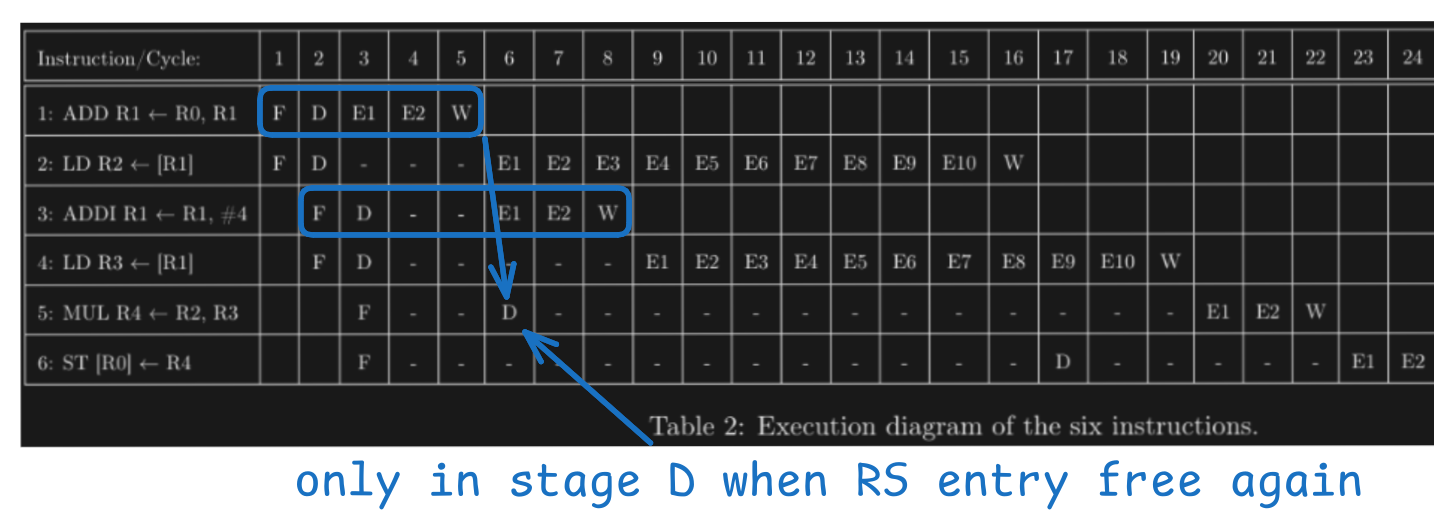
Data forwarding?
- NO!
8. Systolic Arrays
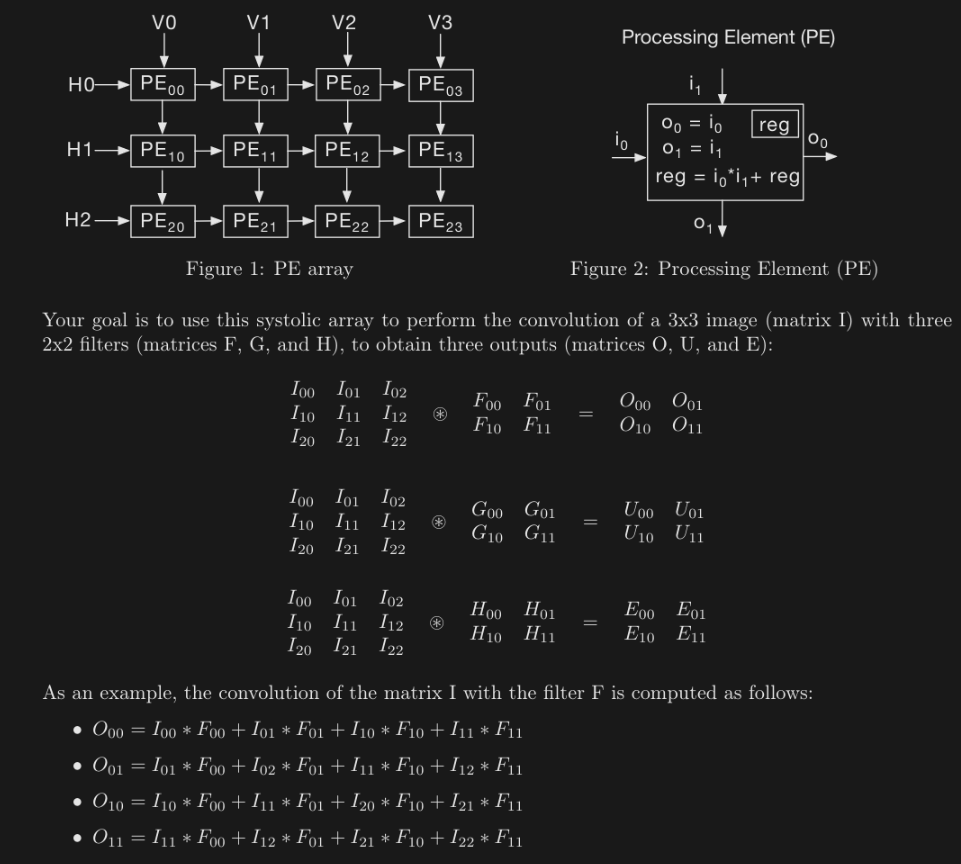
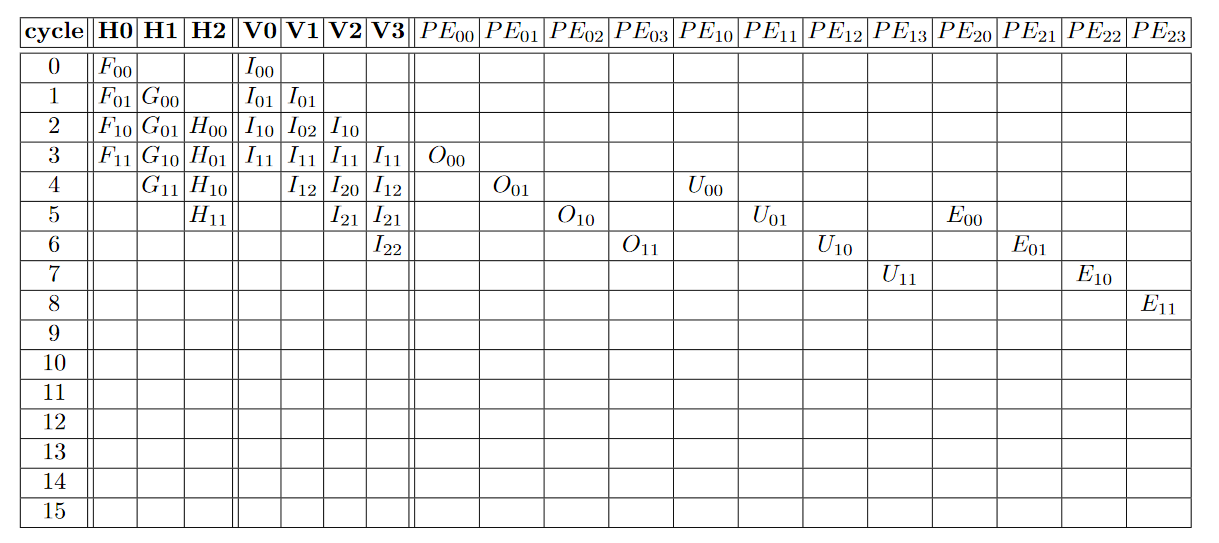
Notice the shape 3x4
- Each element of the convolution kernel is multiplied with 4 of the matrix
⇒ Matrix is fed block-wise into the top
⇒ convolution kernels each get one row
We have to stagger them, so all data is available when they arrive.
9. GPUs and SIMD
for (i = 0; i < 1026; i++) {
	if (A[i] < 33) // instr 1
		B[i] = A[i] << 1; // instr 2
	if (A[i] > 33) // instr 3
		B[i] = A[i] >> 1; // instr 4
}
a)
Warps =
33 warps = 32 with 32 threads, 1 with 2 threads.
b)
Maximum possible → we want the fraction “threads doing shit”/“threads * warps * instructions” to be maximal.
so we want to have the
- 32 full warps to do as much as possible
- 1 warp with 2 to do as little as possible
this is split by instruction, counting threads:
- isntr 1:
1026 = 32*32+2→ all 1026 threads execute the first
- instr 2 / 4:
1024 = 32*32→ only the 32 first warps to 2 or 4
- instr 3:
1026 = 32*32 + 2→ all 1026 do the last instr
and this is out of a maximum of:
- instr 1, 3:
1056 = 32*33i.e. 33 full warps
- instr 2 or 4:
1024 = 32*32as only the first 32 warps actually get there- so no cycles wasted for the last warp
the 32 warps execute 1, 3 and either 2 or 4 as a block (so for each warp choose either 2 or 4, i.e. A[i] < / > 33, but no mix).
The final warp should do as little as possible, so only execute 1 and 4 → A[i] = 33.
c)
What needs to be true about A for this to happen: (3 cases)
- for the first 1024, every consecutive 32 elements of
A- every element either < 33 OR > 33 (not mixed)
- for the last two:
A[i] = 33
d)
Minimum utilisation:
- each warp executes all 4
- so mix of < 33, > 33.
- last warp executes all 4:
- exactly 1 < 33 and 1 > 33
this gives
e)
for every consecutive 32 elements of A for the first 1024:
A[i] < 33for one, > 33 for another, the rest should be= 33.
last 2 elements:A[1024] > 33,A[1025] < 33so exactly a mix.
10. Rev. Eng. Caches
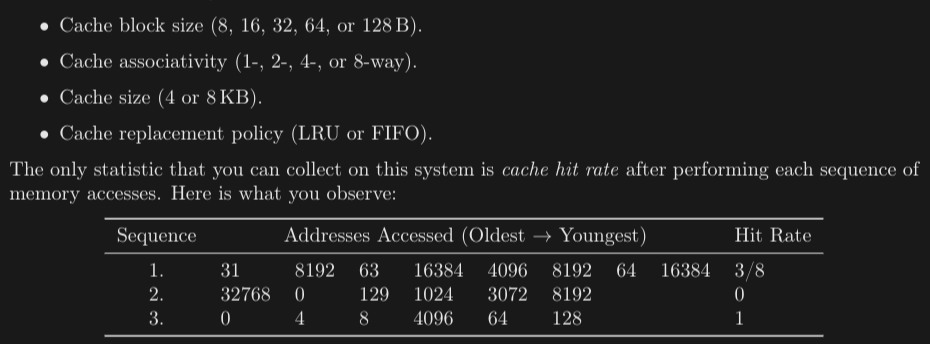
Note: the 1 means 1.0 cache hit rate, so 8/8.
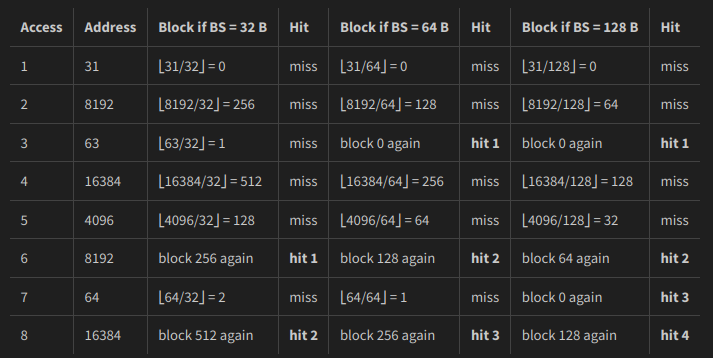
a) Block Size
(8. 16,32, 64 or 128B)
Notice that seq. 1 has 3/8.
Compute the hit rate for all different block sizes, then see which matches.
b) Cache Associativity
(1,2,3,4 or 8 way assoc.)
Block number = bytes address / block size.
Notice that regardless of cache-size or assoc. 0, 8192 16384 and 32768 map to set 0. Let .
-
-
-
-
.
-
64 does not map to set 0 (set 1)
-
4096 maps to either 0 or 1 depending on # sets.
- for cache-size 8192B and 1-way, it maps to set 64
- for all other configs, it’s set 0.
>= 3:
- 16384 is a hit at end of seq. 1 so it must contain {0, 8192, 16384} at least (4096 is open)
⇐ 4: - Because 8192 is not a hit at the end of seq. 2, 4096 must have been set 0 and it’s associativity has to be >= 3, so it’s 4 but ⇐ 4.
c)
(4KB or 8KB)
We now know block size = 64B and 4-way assoc.
Look at Seq. 3.
- 4096 is a hit, so 3072 and 1024 could not have been mapped to → set 0.
for 4-way and 64B block size, we would have
- 4KB cache size →
- sets
- sets
So 3072 and 1024 would map to →
- , mod 32 = 16
- , mod 32 = 16.
As 4096 is a hit, they must have mapped to set 16 → thus size = 8192KB.
d)
(LRU or FIFO)
8192 is a miss in seq. 2, so let’s look at FIFO vs. LRU:
FIFO for set 0
- seq. 1 end
- then seq. 2 :
- on insertion of 32768:
- 0 is inserted back
- thus it’s consistent with 8192 miss
LRU for set 0:
- seq 1. end from LRU, MRU
- seq 2.
- but then 8192 would not have been a miss!
Thus the cache must be FIFO.
Branch Prediction
a)
Lead-In
There is always a NN lead-in to take into account.
This makes sure we have something to index the first branch with.
We have TTT…NT, so prepend the NN lead in. Then we have NN → T, NT → T, etc…
b)
We don’t have to give a value for all entries of the PHT → only those actually taken in the steady state branch history.