15.1 Tomasulo’s
The following video illustrates Tomasulo’s OoO-Execution Algorithm very well:
https://www.youtube.com/watch?v=zS9ngvUQPNM
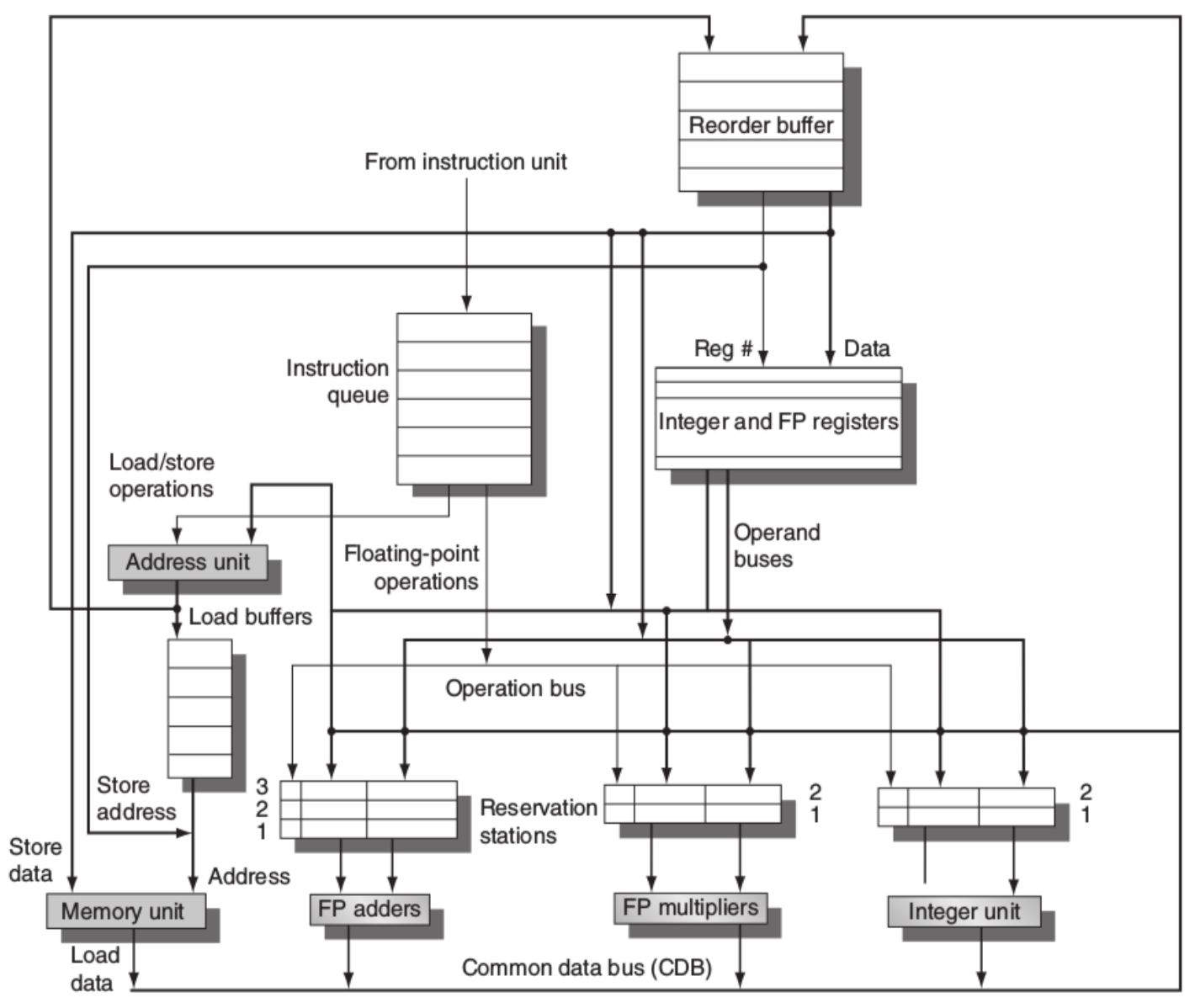
Tomasulo’s creates Reservation Stations which buffer instructions for the various arithmetic-subunits of the ALU, in order to increase the concurrency.
- they gate the “traffic” to the functional units
- the calculations are then actually done when all input values are ready
- they set the tags they are waiting for
These tag the different values and then broadcast the result out to all subscribers, which saves a cycle of register access.
- this happens over the common data bus
15.2 Hazards
There are multiple different types of dependencies between instructions:
- Read after Write (RaW)
- Write after Write (WaW)
- Write after Read (WaR)
The only “true dependency” is a RaW dependency, as we actually need the “updated” value.
There are also architectural dependencies WaW and WaR. These can be fixed by renaming the registers accessed.
15.3 Tomasulo Addition (ROB, RAT)
15.3.1 Reorder Buffer (ROB)
The reorder buffer works by allowing out of order execution of statements, which then commit their results into memory in program order.
15.3.2 Register Alias Table (RAT)
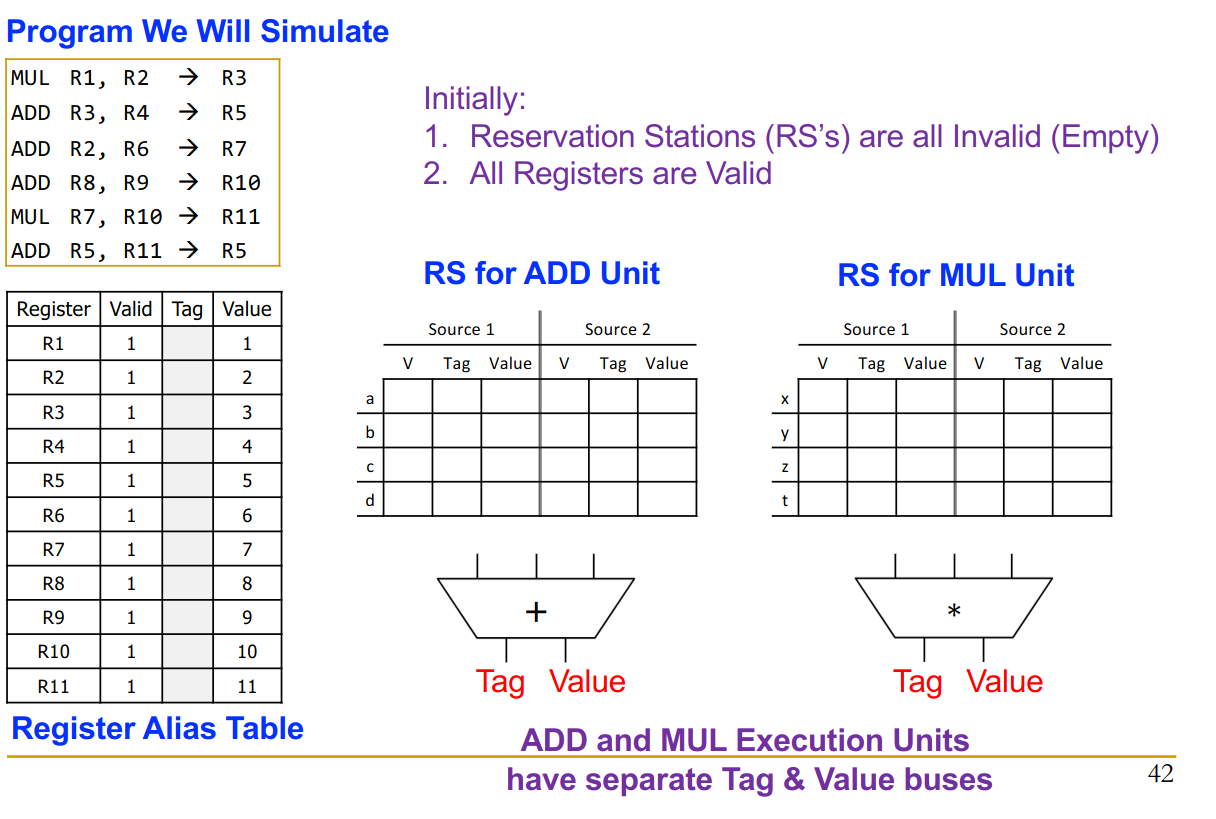
The RAT allows us to reduce the duplication of values. Without it the ROB and register files would each store the value.
With the RAT as a global value store, we can ensure that each component only has a pointer to a value within the RAT.
The RAT eliminates RaW by the tag capture. Tags are handled in-order and only at dispatch.
Example Imagine the following program
I1:  MUL R1 <- R2, R2      -> RS tag A
I2:  ADD R1 <- R1, R3      -> RS tag B
I3:  ADD R1 <- R1, R4      -> RS tag C
I4:  MUL R5 <- R1, R1      -> RS tag D
I1is dispatched → RATR1has tag A.I2is dispatched. It hasR1as a dependency- reads the RAT → replaces
R1byA - this creates a point-to-point link between Reservation station
AandI2source register - after this we can rename the
R1entry in the RAT again → becomesB
- reads the RAT → replaces
I3readsBas a dependency, etc…
This means that the RAT contains an in-order record of which RS gives out which value. Overwriting is fine.