1. Speedup
c)
Amdahl’s: assumes constant problem size
Gustafson’s: assumes constant runtime with variable problem size
2. Pipelining
3.
b) einfach die paar ersten Schritte aufmalen und so extreme Variationen machen, um zu schauen was passiert → Latenz constant oder nicht.
3. Threads
4.
Nutze Helfervariable (boolean oder ähnliches) um irgendwie access zu gaten / ensure the correct order (write → read → write → read, etc…).
b)
Synchronized nötig. Dann ein Beispiel mit einem Bad Interleaving geben → mention that word!
- mention data race on variable
x. - Idealerwise in listen form mit line numbers.
5.
Hier einfach explizit dazuschreiben, diese sind richtig, “wenn threads sterben dürfen”…
Dann ist man auf der sicheren Seite.
4. Fork / Join
int l1 = length / 2;
int l2 = length - l1; // garantiert kompletten coverage!

new Task(start, l1);
new Task(start + l1, l2);
Sequential cutoff nicht vergessen! Einfach bei 1 wenn nichts anderes angegeben.
b) → Recommend doing approx 100-5000 basic operations in the sequential cutoff.
5. Linearizability
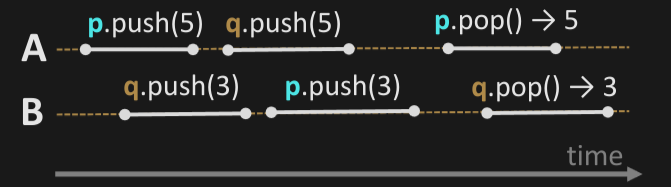
Linearizability
Linearizability Proof:
- Einfach für alle operation seine Sequential history exhibiten → linearisierungs punkte aufmalen.
Linearizability Disproof: Da linearizability composable ist! können wir es für die einzelnen Projektionen H | p und H | q beweisen!
- wenn eine Projektion nicht linearizable ist, ist es die History auch nicht.
Zeigen dass mit den relations es nicht gehen kann, i.e contradiction.
- hier,
p.push(5) < p.push(3) < p.pop(5)und keine overlappings- nicht stack semantik legal.
Example: Happens before ordering gives us
- nur overlappen, i.e. incomparable!
- jede linearization of must have:
- with push(2) and push(3) in some order
- so now there are 2 candidates remaining
- check both, both contradict, i.e. illegal semantic, done.
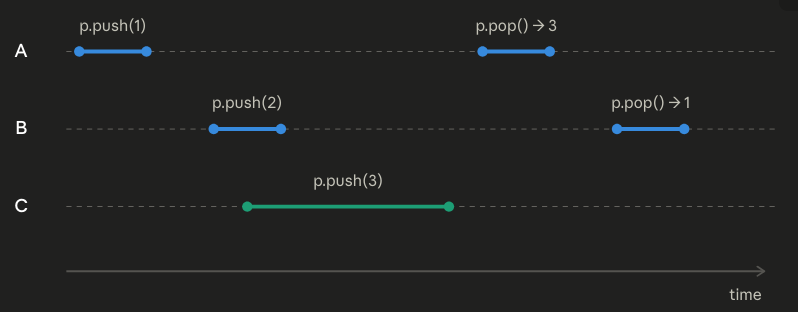
- check both, both contradict, i.e. illegal semantic, done.
Sequentially Consistent
Sequentially consistent Proof:
- give a sequential order of all operations (i.e. merge across threads)
- it must respect PO within threads
- here “all of A, then all of B”
- that is legal with the semantics of the object.
Sequentially Consistent
is SC iff there is a sequential history such that:
- contains exactly the operations of (same invocations / responses)
- respects PO of every thread
- is legal (matches sequential specification of the object)
Sequentially consistent Disproof: (cycle argument)
- Suppose legal Sequential
- Then
q.push(...) < q.pop()and … - then show that a cycle is created.
Thread Synchronization
b) iii)
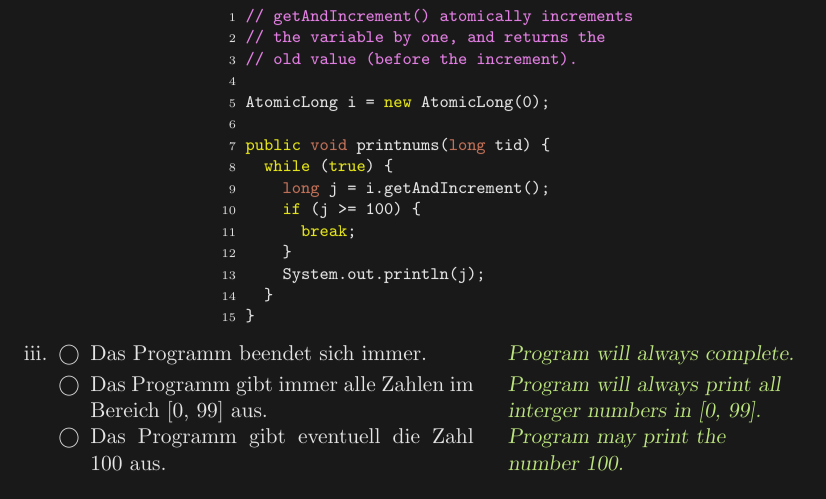
Das programm beendet sich immer → TRUE
Gibt alle Zahlen in [0, 99] aus → TRUE
- da hier
getAndIncrementgenutzt wird, speichert irgendein Thread immer jede intermediate value- es kann nichts übersprungen werden
- würde nur passieren, wenn nochmal
get()called wird!