1. Speedups
d)
For two processors, one with 1.5GGHz, 8 cores, other with 2.5GHz and 5 processors, figure out which is faster for .
Compute the speedup of each processor against 1 core, disregarding the clockspeed.
Now multiple the speedups with the clock frequency → .
Da , ist option B besser.
Das funktioniert, da für beide gleicher Work ist, und durch multiplizieren mit Clock-Speed kann man sie dann vergleichen.
2. Pipelining
b)
Totale time = first cycle * (N - 1) * max(time_stage).
d)
Massive Rechenfehler lol
→ compute alle vergleiche independently, schau was optimal ist.
3. Task Graphs
b)
Wieviele Prozessoren sind nötig?
NICHT Zählen wieviel nodes per Layer und dann max nehmen!
- man muss sich die einzelnen nodes pro layer anschauen und rechnen mit wievielen prozessoren alle schnell fertig sind
→ Layer 3 = 20, 30, 100, 60. Hier reichen 3, da 20 und 30 mit einem Prozessor fertig werden, bevor 100 fertig ist.
- note, 20 + 30 + 60 > 100, also geht es nicht mit 2.
Dann ist die Execution time → equal to critical Path. da wir mit mehr als 3 prozessoren keinen Speedup mehr kriegen
Deps
When drawing in the processing times, keep in mind the time at which node finishes is .
Check: wenn critical-path time < time mit split up → noch nicht ideal split gefunden!
c)
Knoten mit 100 aufteilen → 4 prozessoren mit critical path 300.
Knoten mit 80 autteilen → 3 prozessoren mit critical path 300
→ solution mit 80 ist ideal.
4. Wait/notify
thread.interrupt() called den interrupt. Mit thread.join() kann man dann warten bis sie fertig sind.
→ Check das extends Thread gegeben ist.
ExamPile
public Exam pollExam() {
	synchronized (this) {
		while (exams.size() == 0) wait();
		// why no notifyAll?
		return exams.poll();
	}
}
Das notify ist hier nicht sinnvoll, da es ja keinen anderen wartenden thread interessiert, wenn ein exam wieder da ist
- wir entfernen es ja hier direkt wieder → ergo nur wir brauchen es sehen
Note: in addExam() ist wohl ein notify → wir warten ja hier genau auf dieses Notify
Fork/Join Framework
Im Fork/Join Framework wird
RecursiveTask<Double>verwendet um einen Wert zurückzugeben.RecursiveActionverwendet, wenn in-place alles geschieht
6. Locks
a)
Fair: A fair lock is acquired in the order it is requested.
“fair lock is acquired in the order the threads enter the doorway”
Deadlock-Free: A lock is deadlock free if at least one waiting thread acquires it eventually → system wide progress.
Starvation-Free: A lock is starvation free if a thread that requested the lock will eventually acquire it.
Lock-free: infinitely often some method call completes, i.e. the system as a whole makes progress even if individual threads starve.
Wait-free: Every method call by every thread completes in a finite number of its own steps, regardless of speed or failure of other threads.
b)
Starvation-free + deadlock-free ⇒ fair?
No, the filter-lock (or Dekker) for example is not fair.
“In a fair lock, threads cannot overtake each other. In a starvation free lock if threads A, B, C request the lock in that order, it is fine to give the lock to A, C, B (in that order). But this is not fair.”
c)
fair ⇒ starvation + deadlock-free?
False: simple lock that never returns. It’s fair, but it’s also not starvation free.
7. Linearizability
-
Jede mit
synchronizedannotierte Methode hat einen Linearisierungspunkt. → TRUE- ja weil, mutex auf dem Monitor des Objekts. Totally ordered and never overlap.
- → jeder beliebige Punkt in der Methode ist linearisierungspunkt
- false, if we pass in non-synchronized objects into the method.
wait()in der Methode
- ja weil, mutex auf dem Monitor des Objekts. Totally ordered and never overlap.
-
Sequentiell konsistentes Speichermodell schreibt vor, das alle Aktionen eines Threads in PO sichtbar werden → TRUE, def. SC
8. Barriers and Semaphores
a)
public synchronized void acquire() throws InterruptedException {
    while (counter <= 0) this.wait();
    counter--;
}
public synchronized void release() {
counter++;
this.notify();
}Note notifyAll vs. notify here
- both would work, but since only one thread can reacquire the lock ⇒ only wake up one sleeping waiting on counter
b)
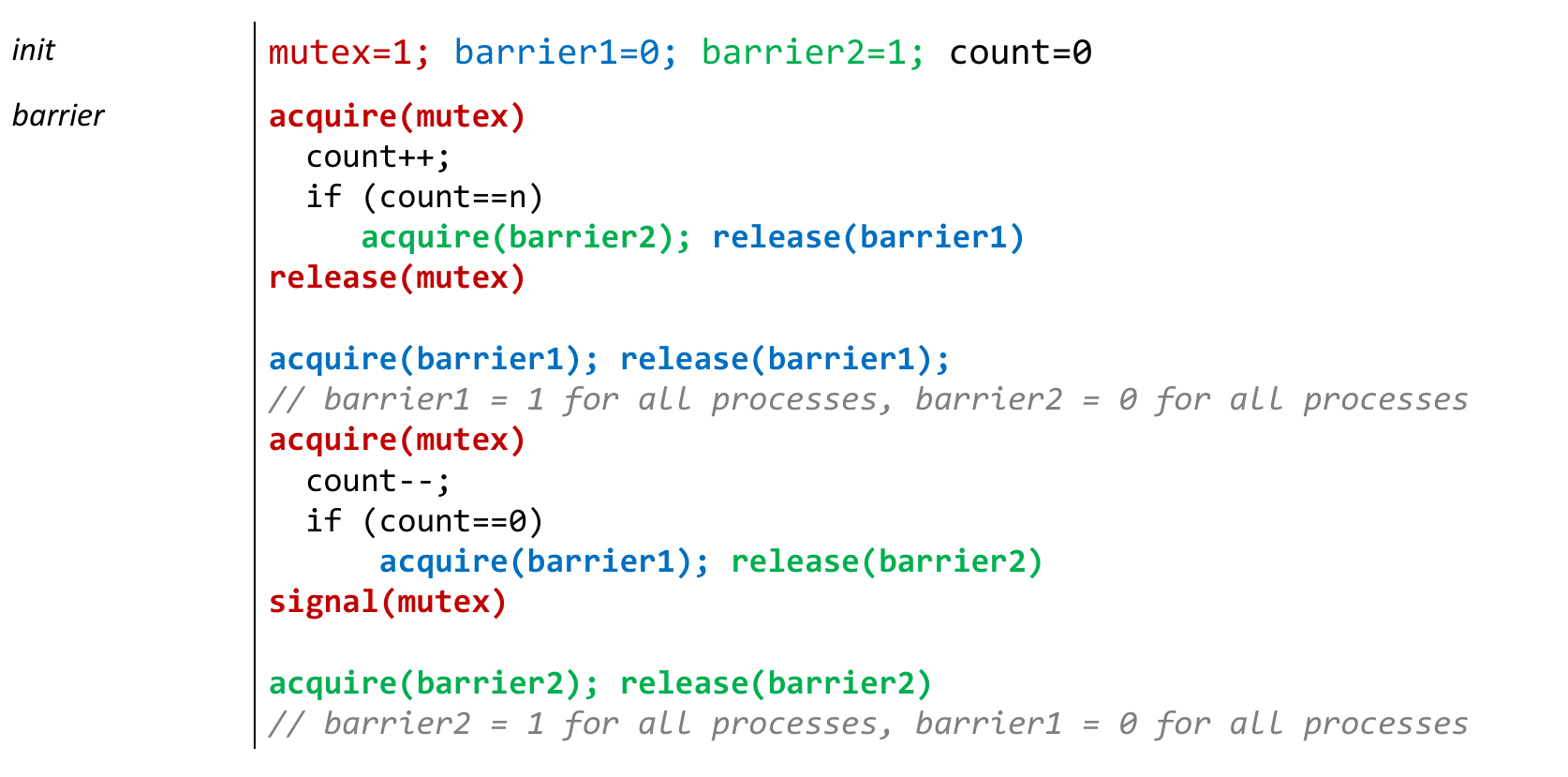
Learn that by heart!
9. MPI
b)
Eliminiert message-passing (MPI) alle möglichkeiten für deadlocks?
Nein → sie müssen immer noch einen weg haben zu synchronizen, um zu funktionieren (barriers, etc…). Wir können immer noch auf messages waiting mit send, recv
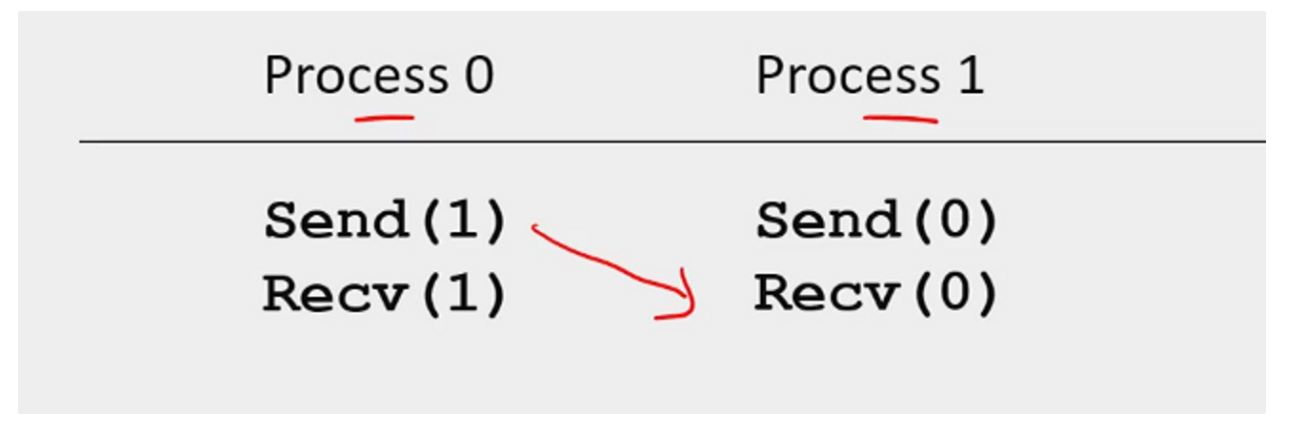
Note: ssend, not send (for synchronous send).
10. Mixer
b)
Explain ABA, using an example.
“Some atomic operations, such as CAS are used to compare a value of a register to an old value, assuming if they are equal that the state of a datastructure did not change in between. This assumption can be wrong, i.e., if we use a node pool and delete and later reuse a node.”
c)
Two techniques to prevent ABA.
”
Usually the ABA problem applies to pointers. We use some bits of the address to use as a counter, incrementing it every time we change the pointer.
This counter might overflow, and thus it makes the ABA problem only less likely.
Another technique is to have a seperate datastructure that contains all elements which have been changed.
”
or use DCAS, LL/SC, Hazard Pointers.
d)
TATAS Lock.
TATAS lock uses non-atomic (but still volatile! otherwise no guarantee we ever get updated value) read first, which avoids the more expensive atomic-reads while the lock is still taken.
void lock(AtomicBoolean flag) {
	while (flag.getAndSet(true)) {
		while (flag.get()) {} // <- non atomic, but volatile read
	}
}

void unlock(AtomicBoolean flag) {
	flag.getAndSet(false);
}
volatile read compiles to an ordinary mov → no fence, no lock prefix.
Hardware already guarantees Load-load and load-store ordering, the only thing the volatile does is constrain the JIT → forbids hoisting the load out of the loop:
while (true)  { while (flag) {} }
// can be JITted to
if (flag) { while (true) {} } // hoisting
This read is cheaper than atomic RMW.
TATAS does not prevent “release storm” → when false is written, all treads try to write (exponential backoff is needed).