17.1 Motivation for STM
17.1.1 What’s wrong with Locks
Convoying: Threads pile up while waiting for a lock held by a descheduled thread.
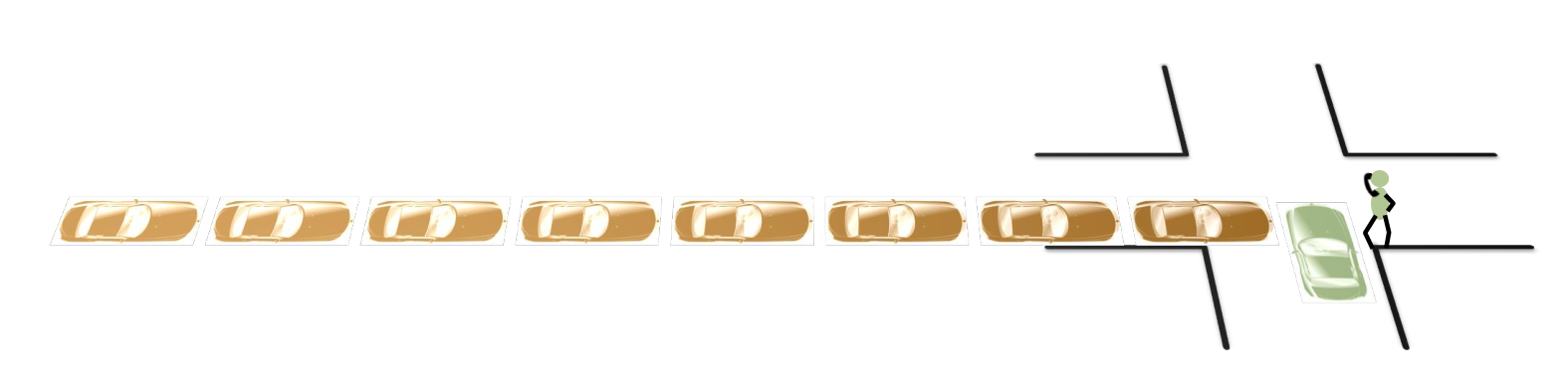
Priority Inversion: High-priority thread is blocked by a low-priority thread holding a needed lock.
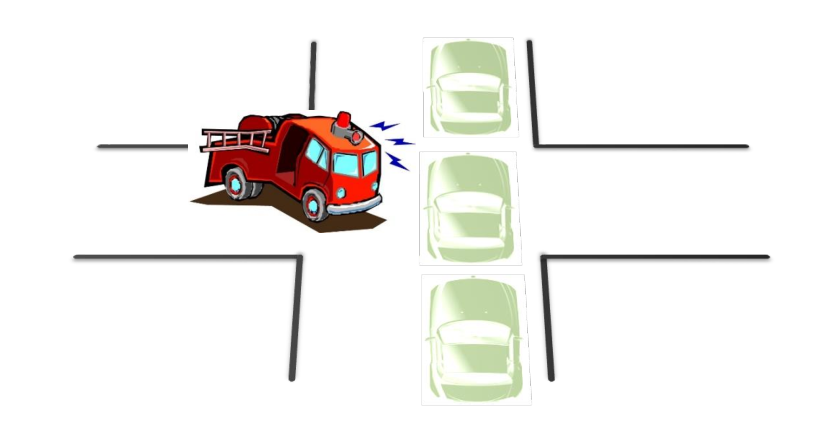
Could solve by giving the thread holding the lock the priority of the thread with the highest priority waiting for it.
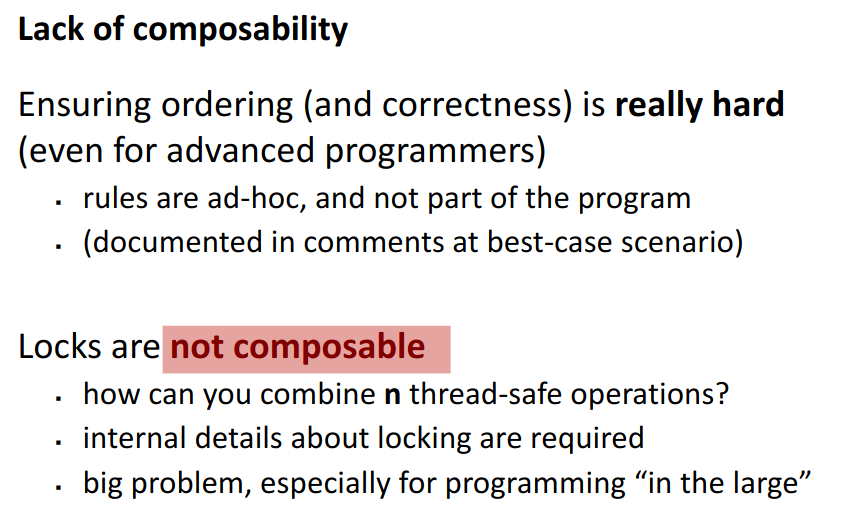
Lack of Composability: combining independently developed thread-safe modules using locks is difficult and error-prone
→ deadlocks from unforeseen interactions → you need to understand internal locking details.
17.1.2 What’s wrong with Lock-Free (using CAS)
Complexity: Lock-free algorithms are subtle and hard to prove correct
Atomicity illusion operations often need multiple CAS steps
- need tricks (like the head/tail placeholders)
- DCAS
ABA Problem
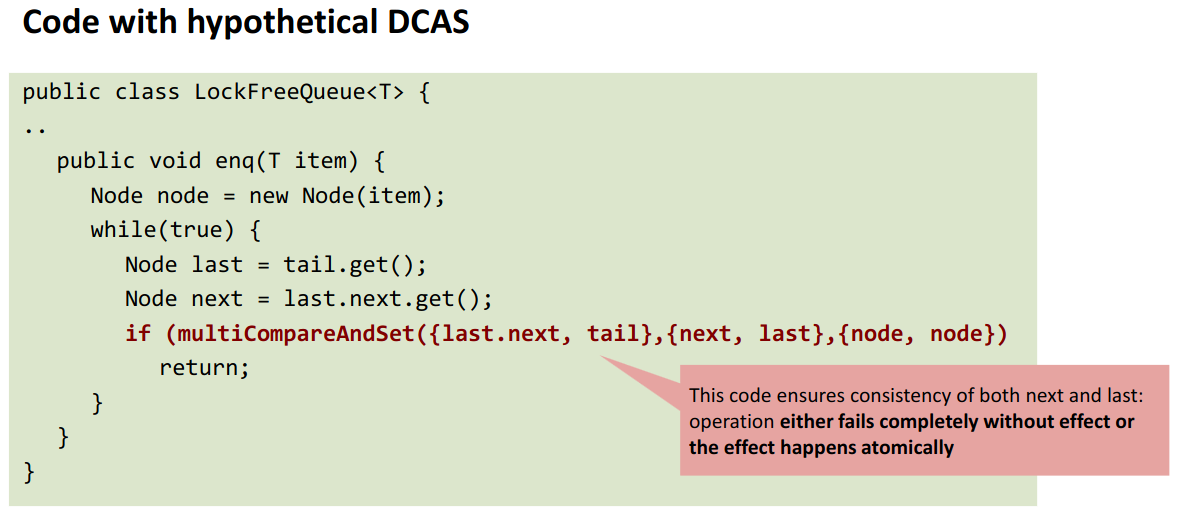
→ having a multi-compare-and-set operation would solve our issues
this shows we need a “high-level” atomic operations.
It could look like this:
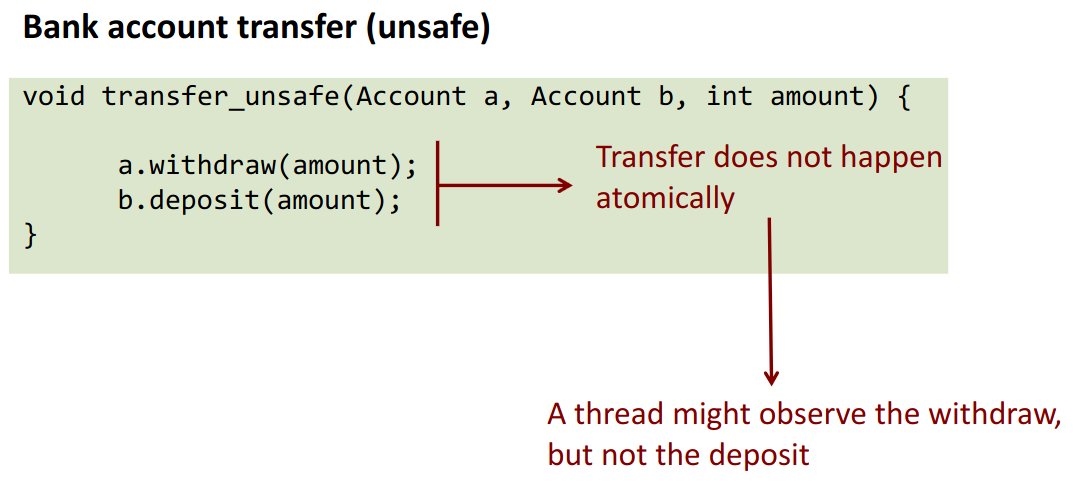
17.1.3 Bank Account Transfer
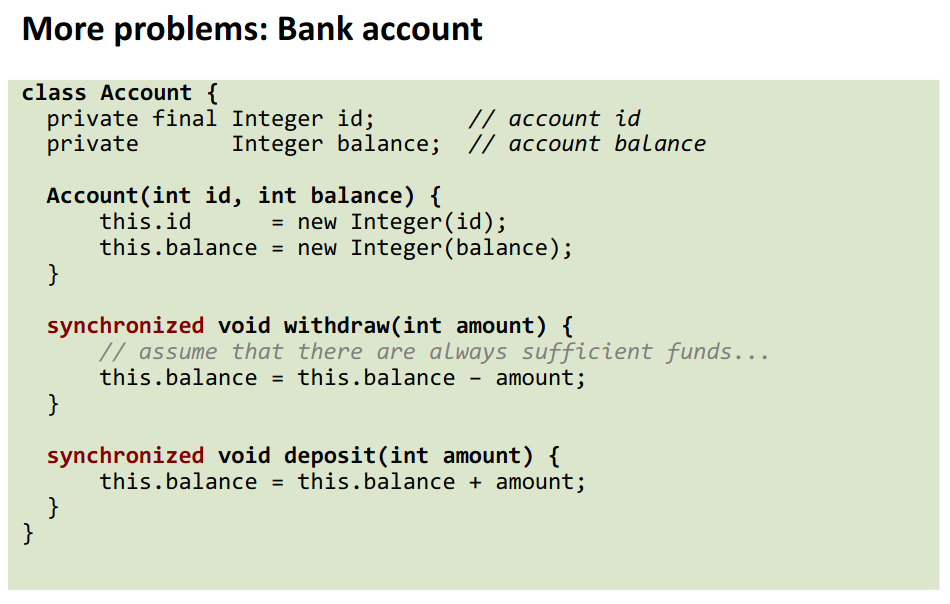
Problem 1: not atomic, could be descheduled and have stale value
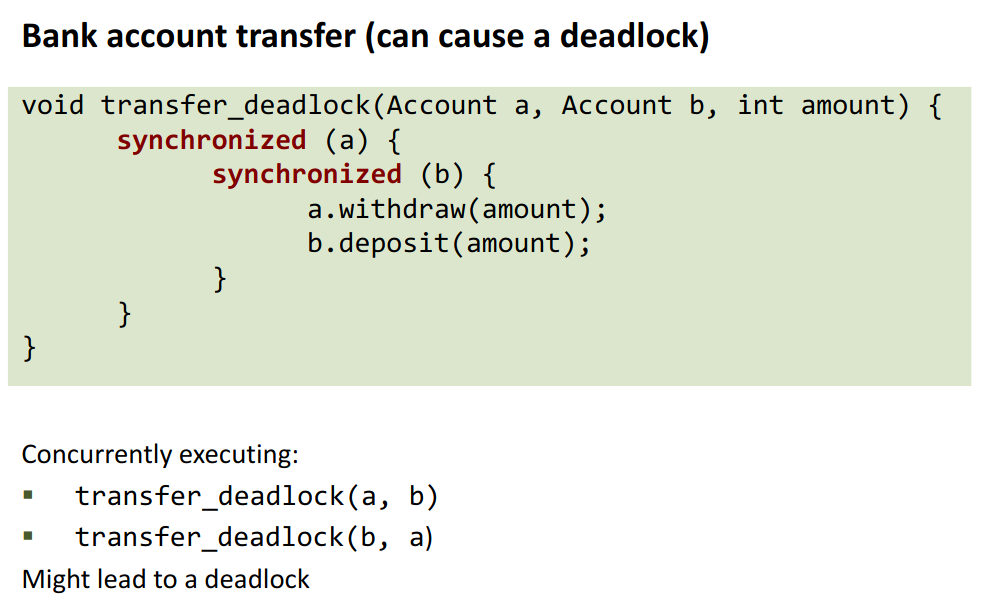
Problem 2: deadlock due to wrong order of locking
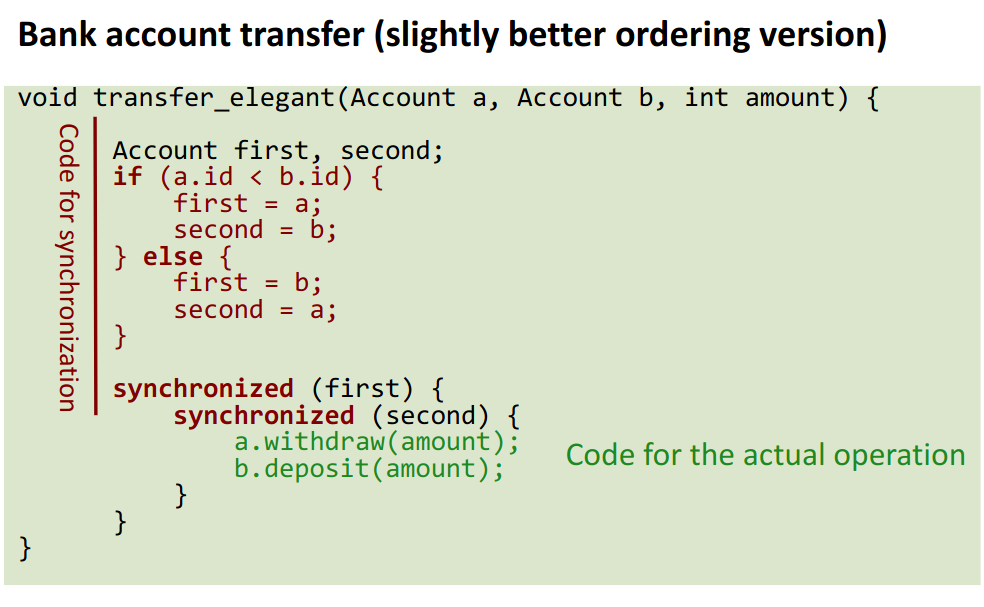
→ need to lock in account id order.
But this is hard to keep consistent, etc… What if there were more than 2 accounts, etc…
We always need to know in which order to lock, etc… When we call transfer in a higher level piece of code that also uses locks we need to be careful! → not composable
17.1.5 Solution?
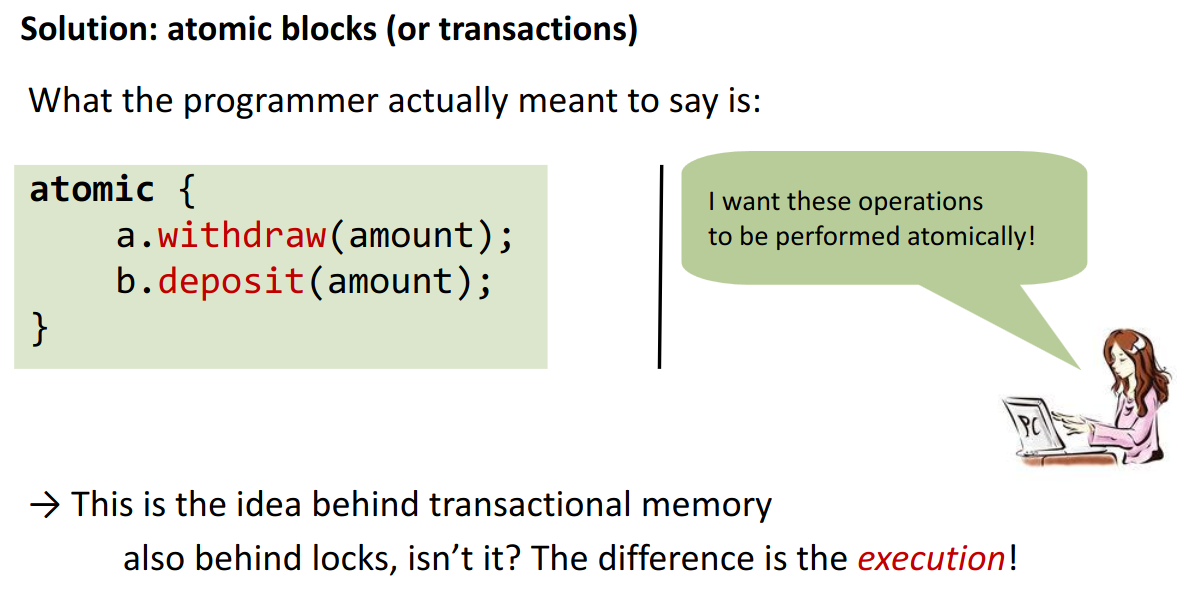
17.2 Transactional Memory
The programmer explicitly defines atomic code sections.
The programmer is then concerned with:
- what: what operations should be atomic
we don’t want to have to handle the “how” → left to the system
This is a declarative approach.
Transactional Memory is:
- simpler and less error-prone
- higher-level (declarative) semantics
- composable
- optimistic by design (does not require mutual exclusion)
- we only pay a cost when there actually is contention, not like with locks
TM executes transactions atomically.
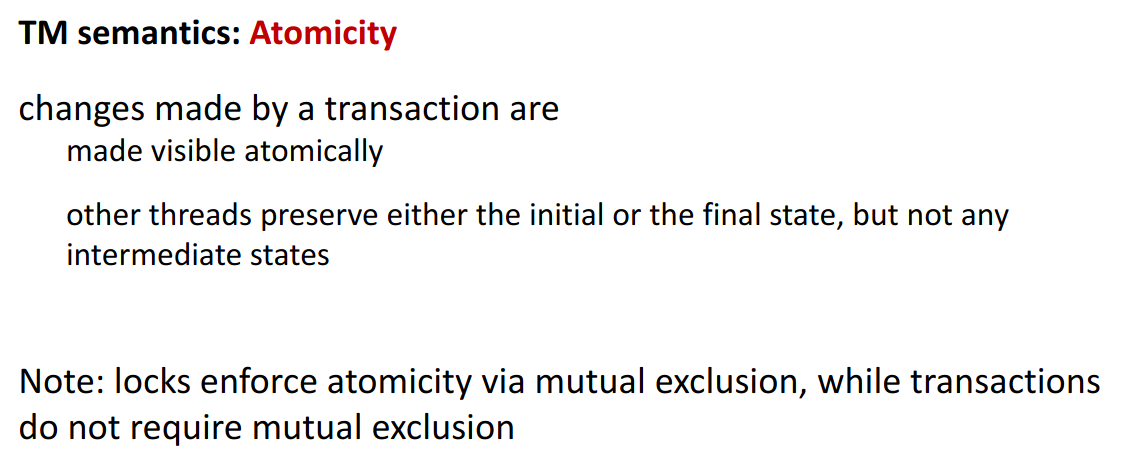
It does this by guaranteeing isolation.
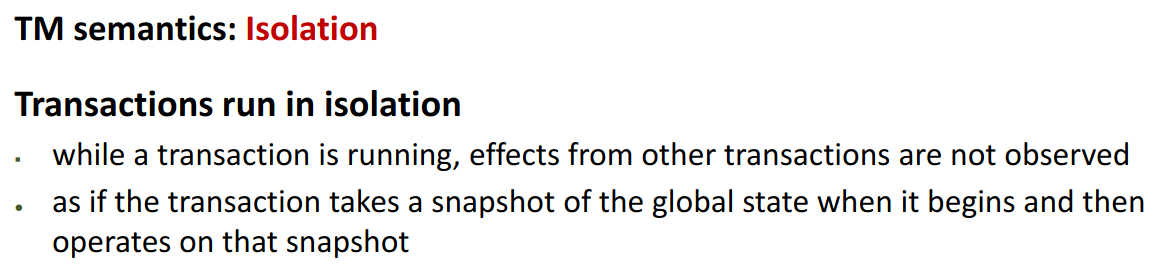
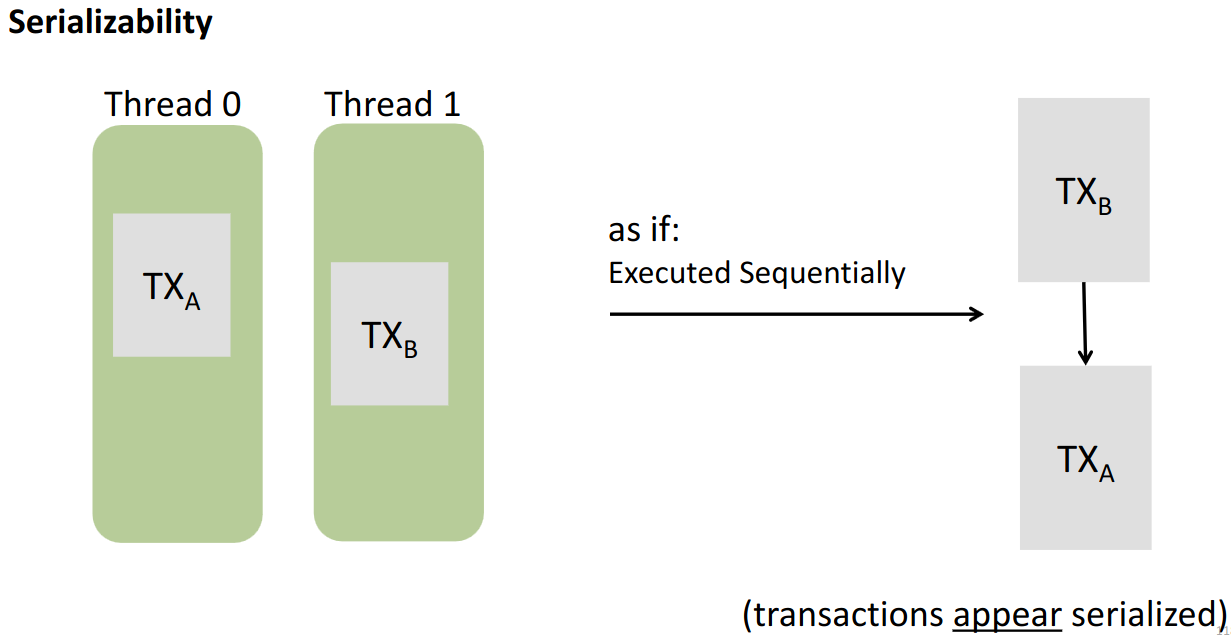
TM guarantees us:
- Atomicity changes made by a transaction become visible all at once → on commit
- we cannot see intermediate states
- not achieved using mutual exclusion, like locks do it
- Isolation transactions execute as if they were running alone → snapshot of the state before.
- Serializability the concurrent execution of multiple transactions must be equivalent to some sequential execution
- final outcome is consistant with a serial ordering
- otherwise we’d be violating atomicity and isolation…
Note: these properties are inspired by the ACID principles of databases:
- atomicity
- consistency
- isolation
- (durability)
17.2.1 How is TM implemented
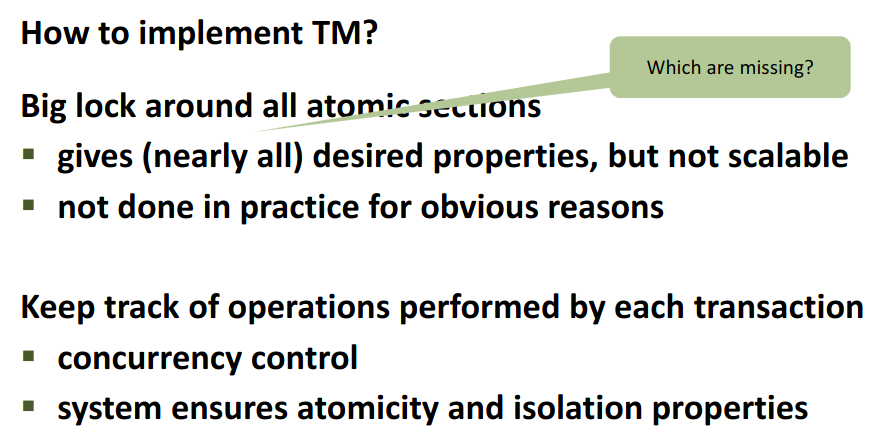
Using a Big Lock is not:
- optimistic
- composable
17.2.2 Conflicts
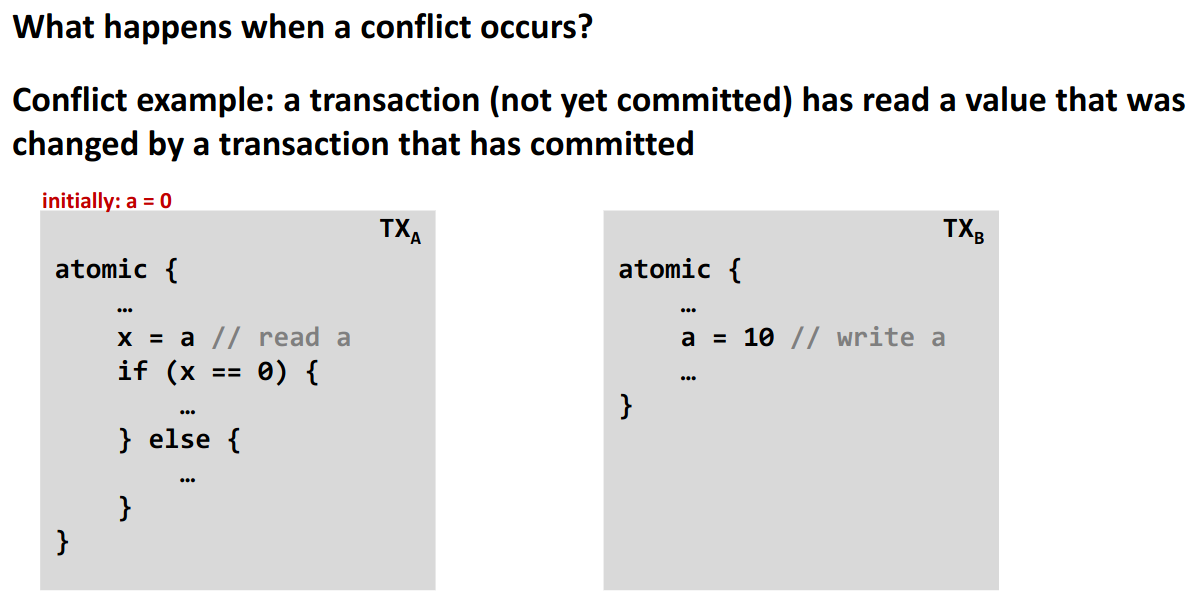
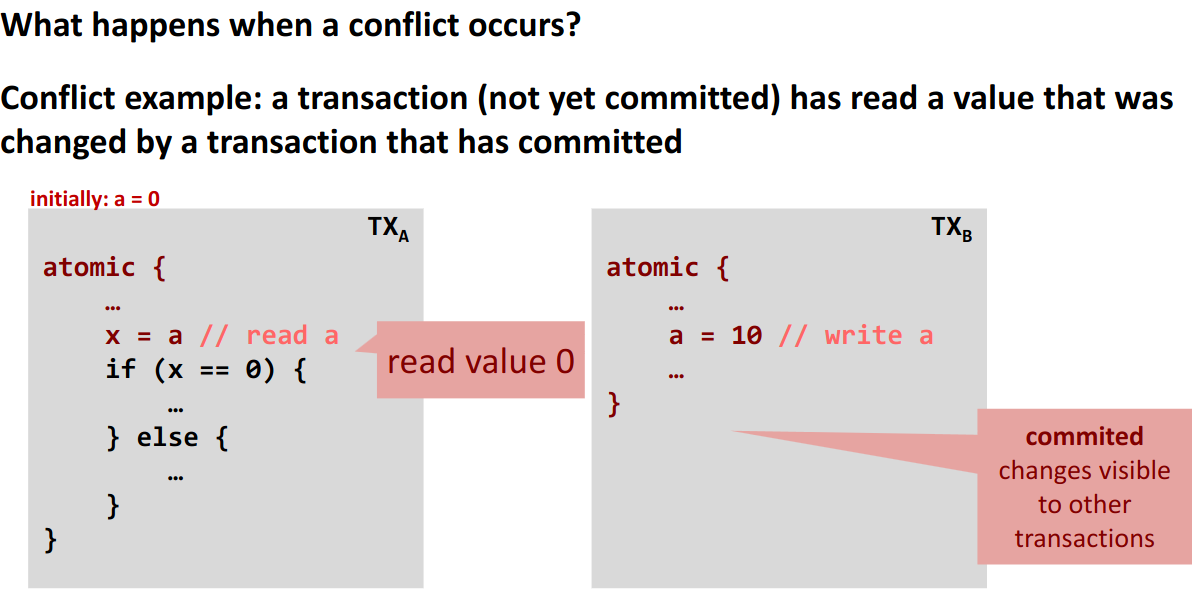
Thread A started, but didn’t finish the transaction. It already read in x = a.
Then thread B starts, writes a = 10 and commits.
Not that needs to be visible to all threads!
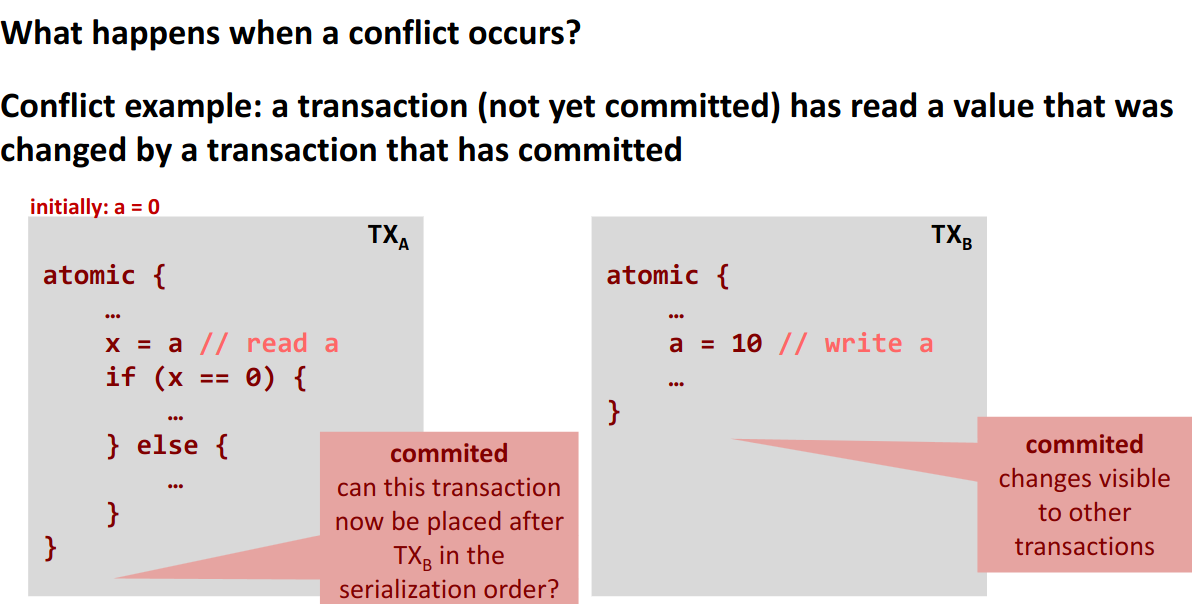
So whatever A did cannot occur after B’s commit in the serialization order!
Otherwise we’d have a magically changing value…
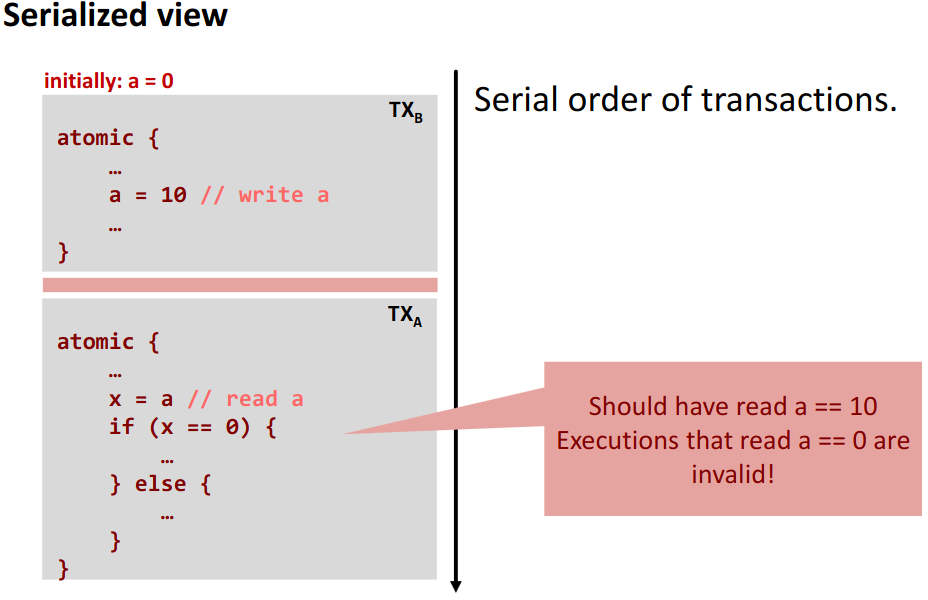
The solution is the concurrency control (CC) mechanism.
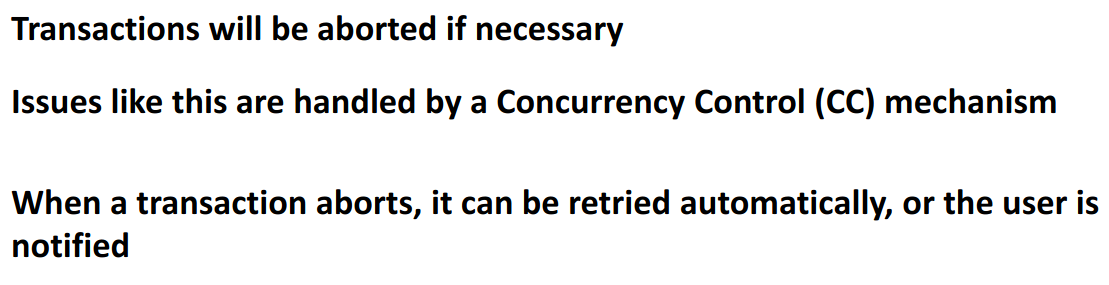
The CC mechanism must detect the conflict of A having read from a location subsequently modified and committed by B.
→ it must then abort A’s transaction and make it retry.
Example Bank Account
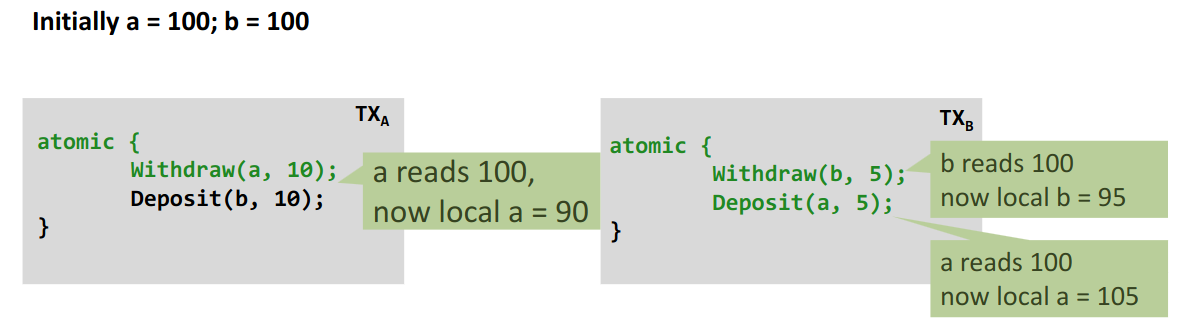
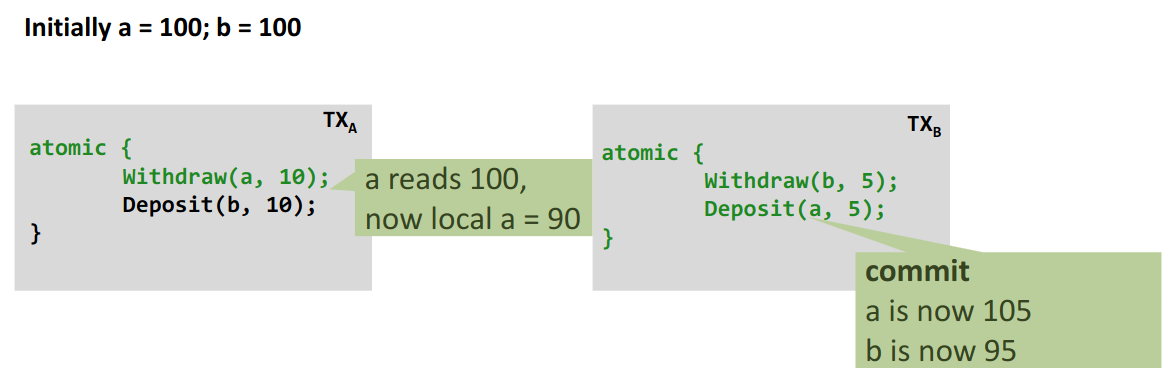
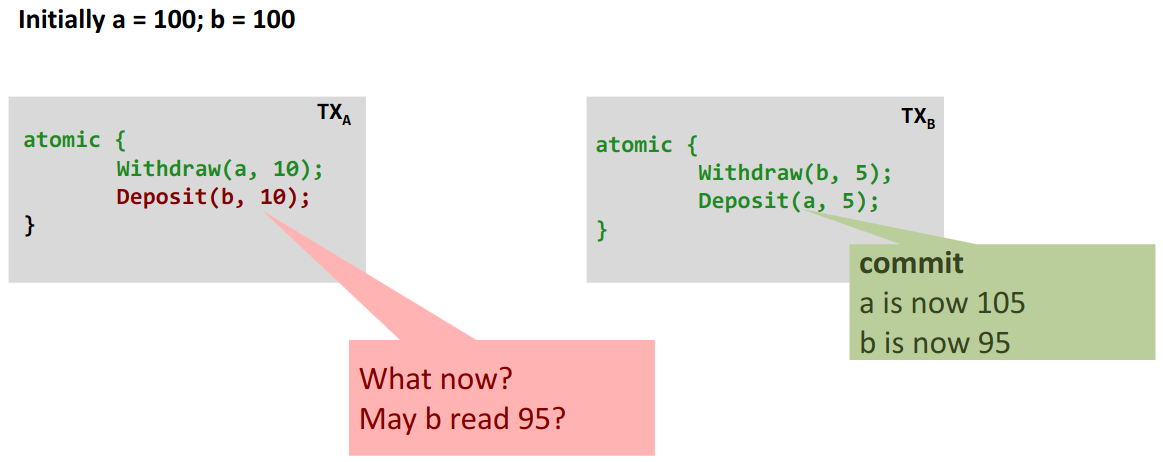
A cannot read b = 95 → otherwise isolation is violated!
So either it must read a = 105 AND b = 95 or not see the transaction by B at all.
Example
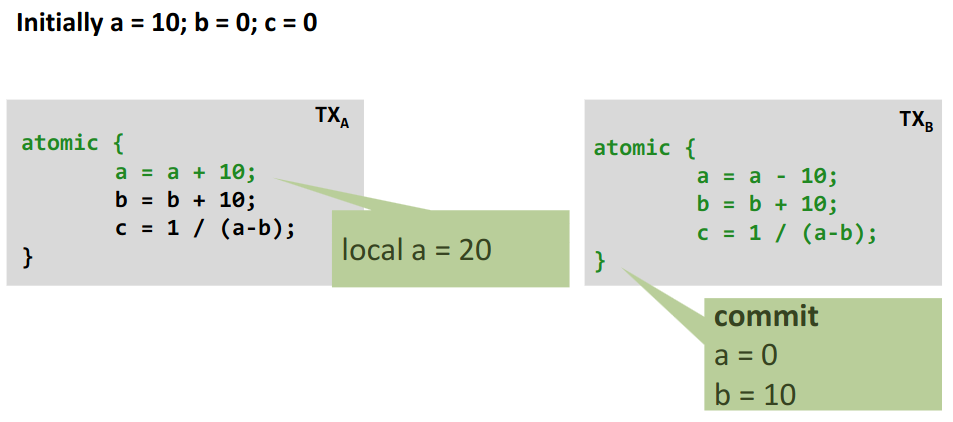
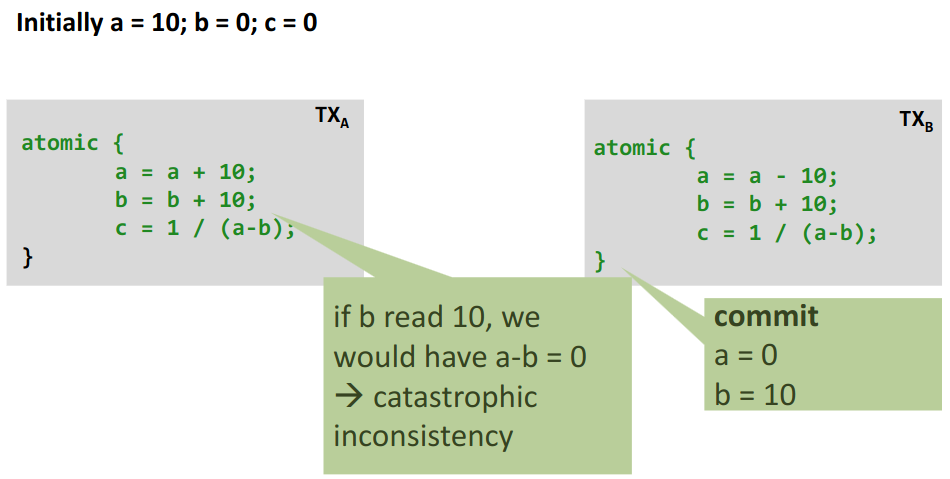
We must immediately abort the transaction as soon as something is inconsistent → otherwise we can have exceptions which could never occur in isolation.
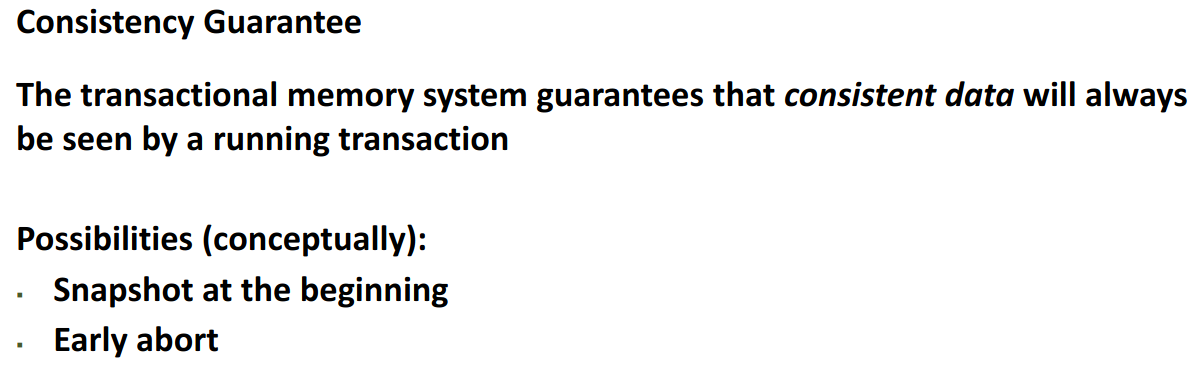
17.2.5 Consistency Guarantee
17.3 Design Choices for STM
STM: Implemented purely in software, often as a library or language feature.
- Pros: Greater flexibility, not limited by hardware resources (can handle large transactions).
- Cons: Can have significant performance overhead (instrumentation, logging reads/writes). Achieving good performance is challenging.
Hardware TM: Implemented directly in processor hardware (e.g., using cache coherence protocol extensions to track read/write sets).
- Pros: Can be very fast, low overhead for common cases.
- Cons: Limited by hardware resources (cache size, buffer sizes). Often cannot handle large transactions that exceed these bounds. Aborts can be expensive.
- Examples: Intel Haswell (TSX/RTM - largely deprecated/disabled due to security flaws), IBM Blue Gene/Q, Sun Rock (cancelled).
17.3.1 Strong vs. Weak Isolation
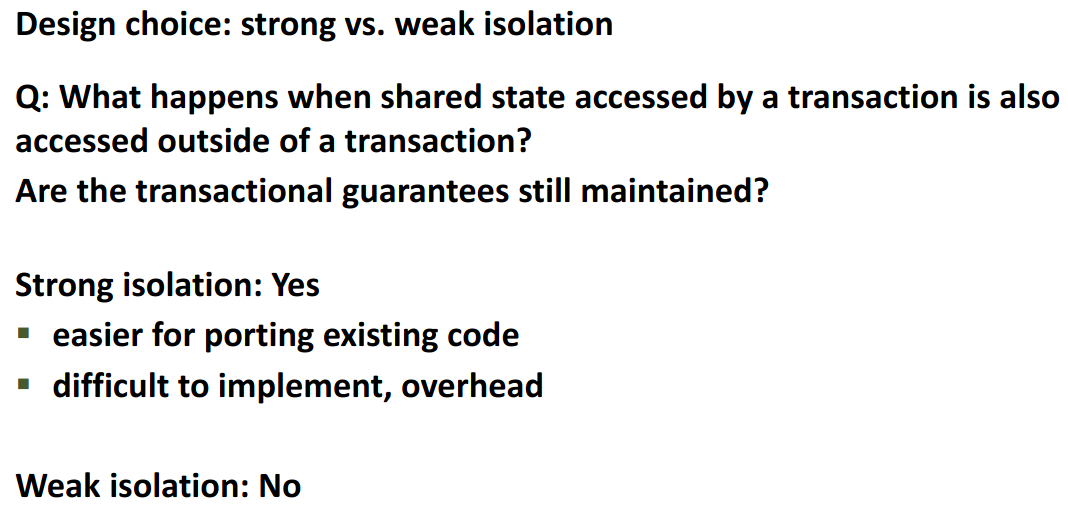
Strong Isolation: if I modify a variable that is also accessed inside a transaction outside?
- does it still guarantee that it’s serializable, isolated, etc…?
- easier to port code
- harder for the TM to implement
Or (weak isolation), we assume all accessed to potentially shared data happens inside transactions
- requires programmer discipline.
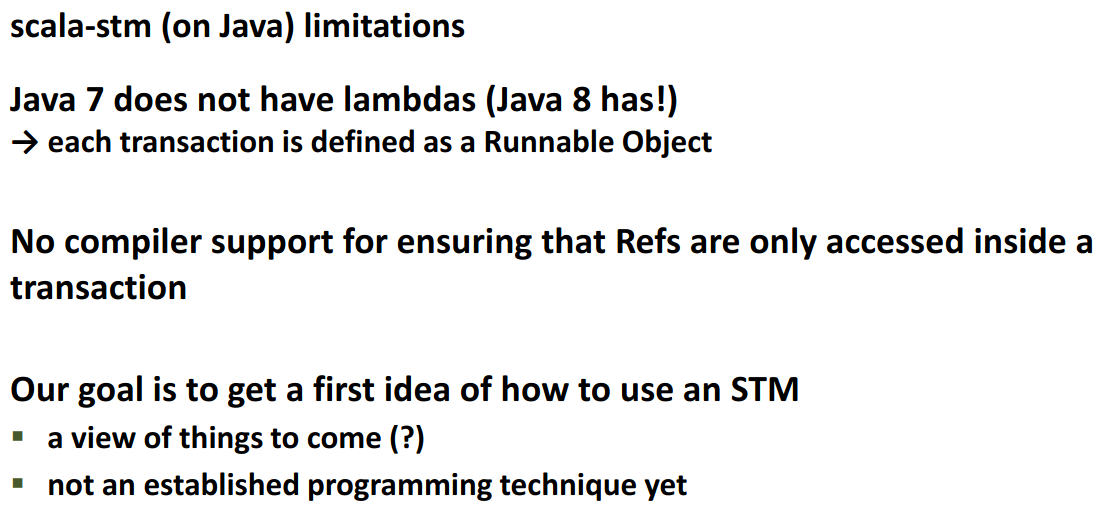
- Scala-STM does this.
17.3.2 Nesting
How do we handle nested atomic transactions. This is necessary for composable transactions!
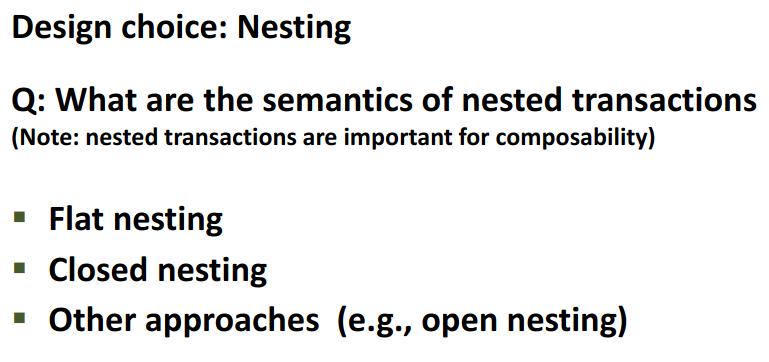
Flattened
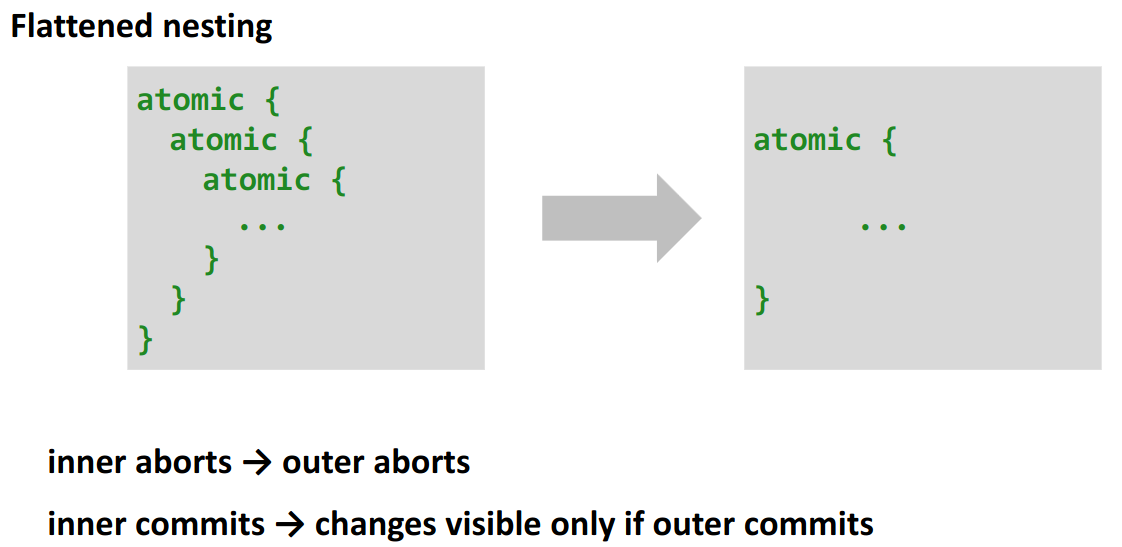
This is simpler, but limits modularity.
Transaction sizes grow → when aborted everything aborted…
Closed
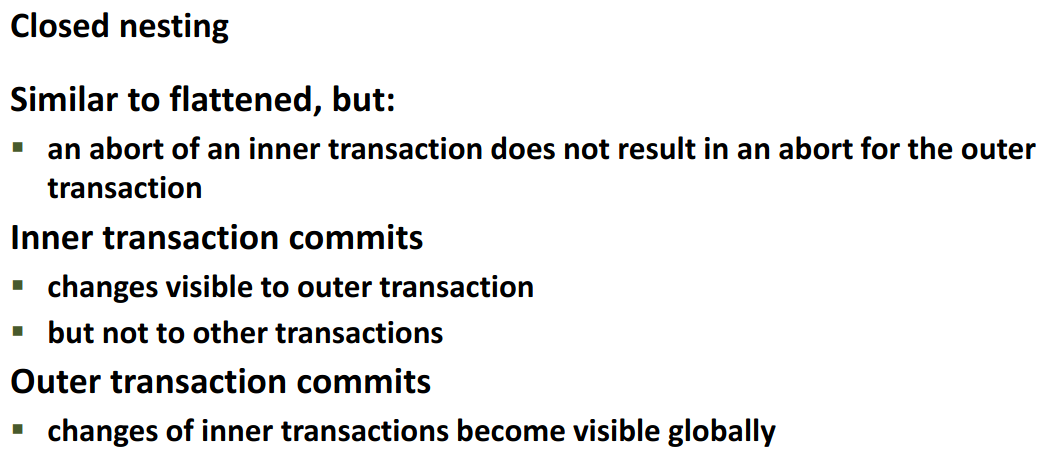
Inner transactions can abort without everything aborting.
Only when outer transaction commits does everything inside get commited globally.
17.3.3 Scope
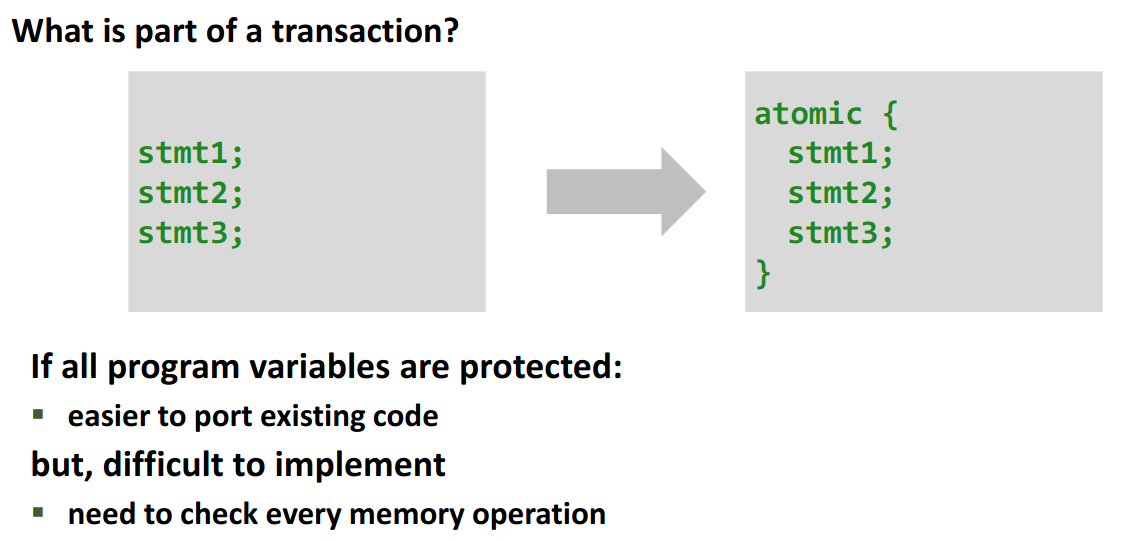
What variables are tracked by the TM implementation?
- all variables?
- easier to port
- high overhead for TM system
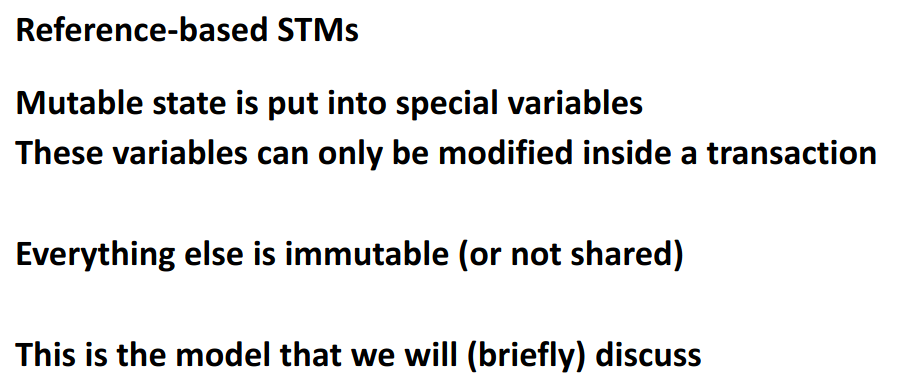
- reference-based
- only special “transactional memory types” are tracked
- explicitly marks mutable shared state
- requires programmer discipline.
- hard to port have to change all variable types
We can isolate special variables that are immutable outside of a transaction.
17.4 Scala STM
17.4.1 Bank Account Example
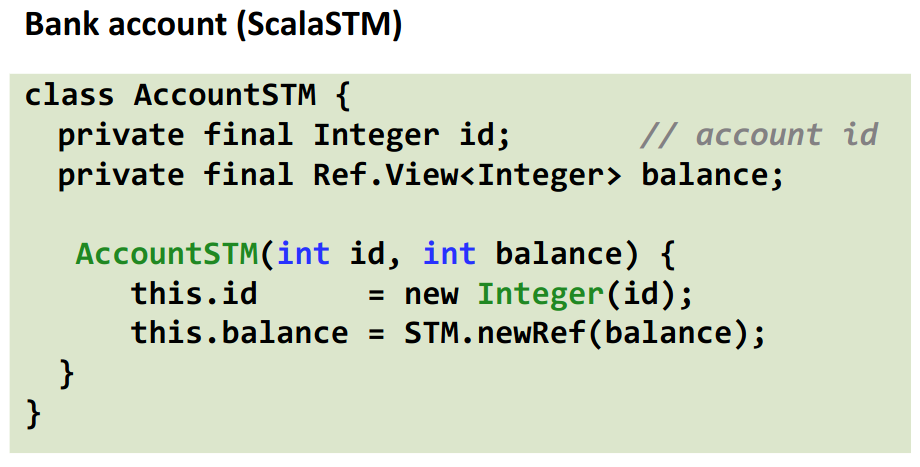
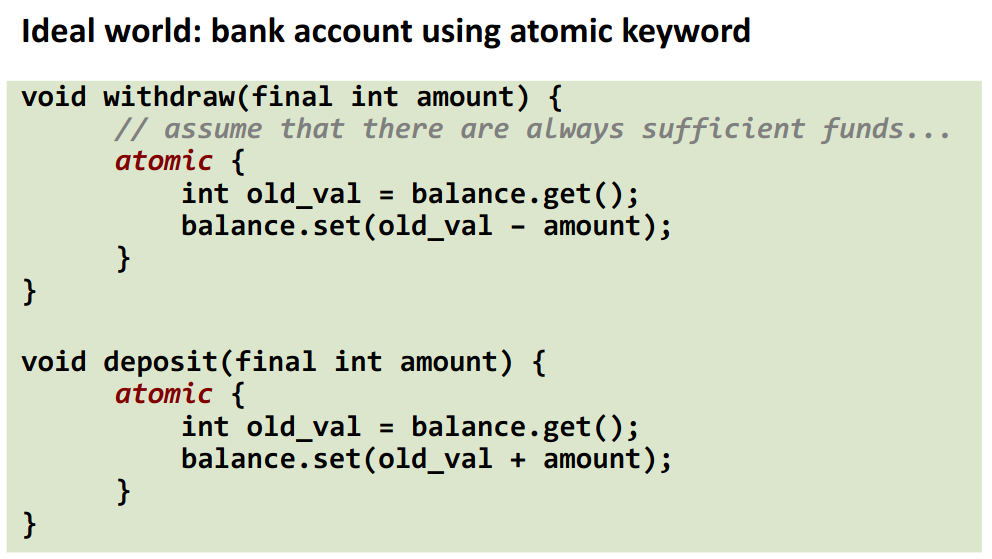
This is how we wish STM looked with compiler support:
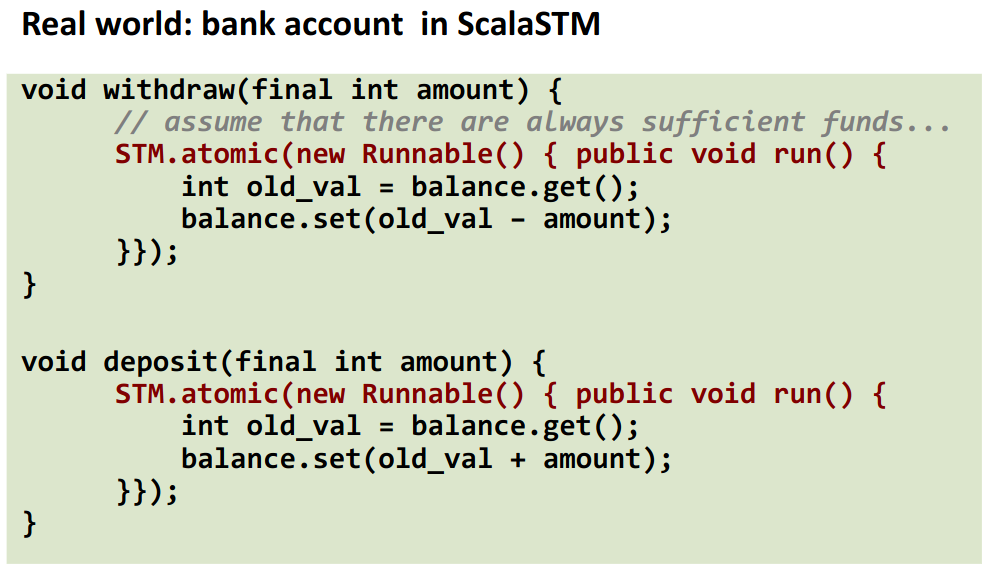
In ScalaSTM, we get the following syntax:
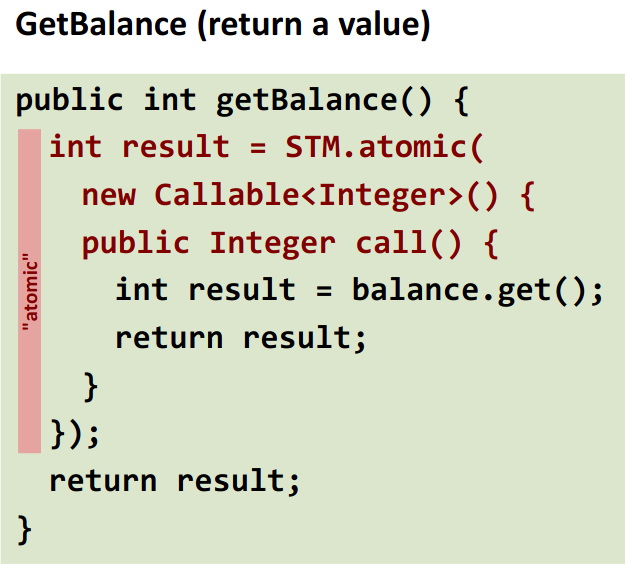
GetBalance:
Transfer Function
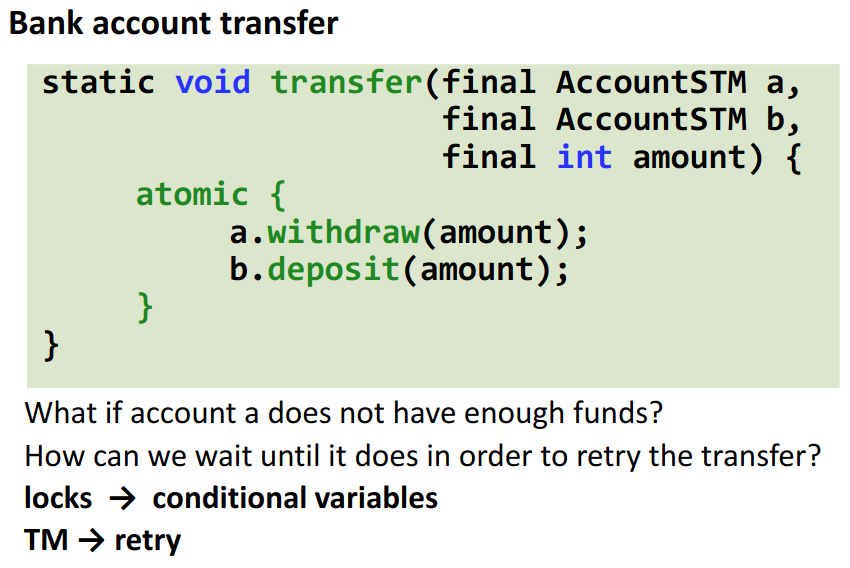
What if account a does not have enough funds?
When something goes wrong, we can use STM.retry() to redo the transaction.
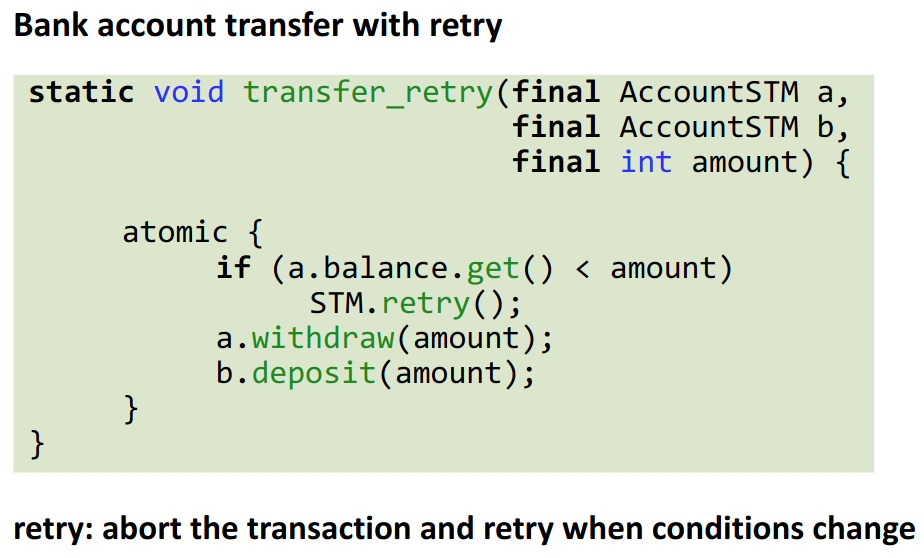
This automatically works because we already have a system to detect changes in variables!
retryis likewait()- if the variables read/modified before
retry()changed →- abort
- put to sleep
- calls again if something changes
Retry in ScalaSTM
The
retry()function is likewait()with locks.
It waits until previously read/modified variables change and then calls again.
How does this work internally?
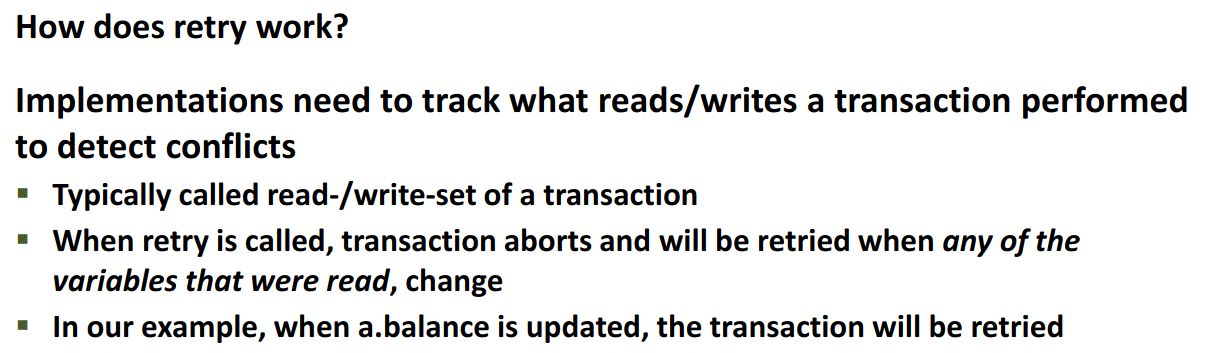
It keeps a set of all variables that were read or written (read-set and write-set)
- keeps track → potentially very large and expensive
17.5 Simple STM Implementation
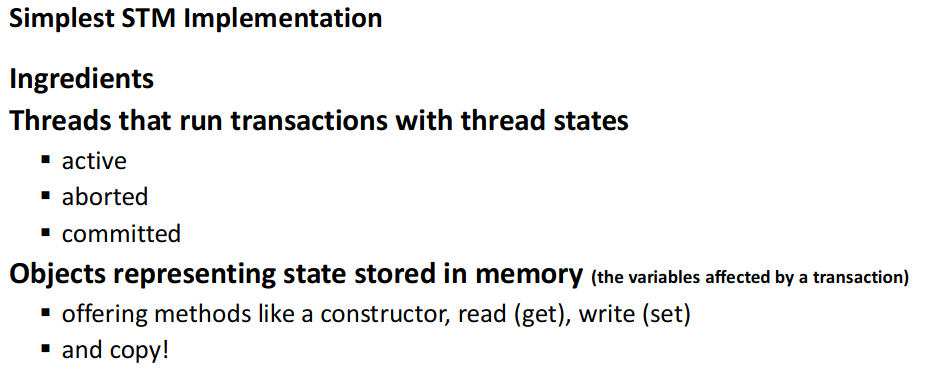
We have the following things:
- Threads: Have states (active, aborted, committed).
- Transactional Objects: Represent shared state, support read (
get), write (set), and crucially, versioning or copying. - Concurrency Control: Needed to ensure isolation and atomicity.
17.5.1 Clock-Based STM System
STM are typically based on a “global clock”.
- this is not a physical time (= wall clock)
- more like an incrementing counter (= logical clock)
is increased everytime the system commits a transaction.
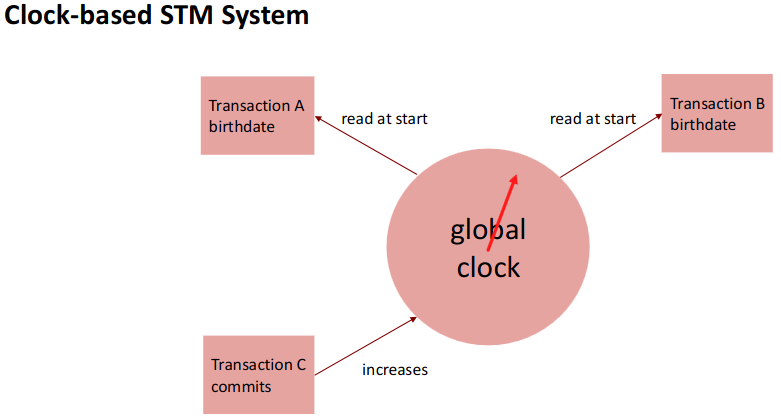
The clock based system works like this:
- A global version clock advances on every commit.
- Each transaction gets a
birthdate(clock value when it starts). - Each transactional object has a
timestamp(clock value when it was last committed). - Transactions maintain local read-sets and write-sets.
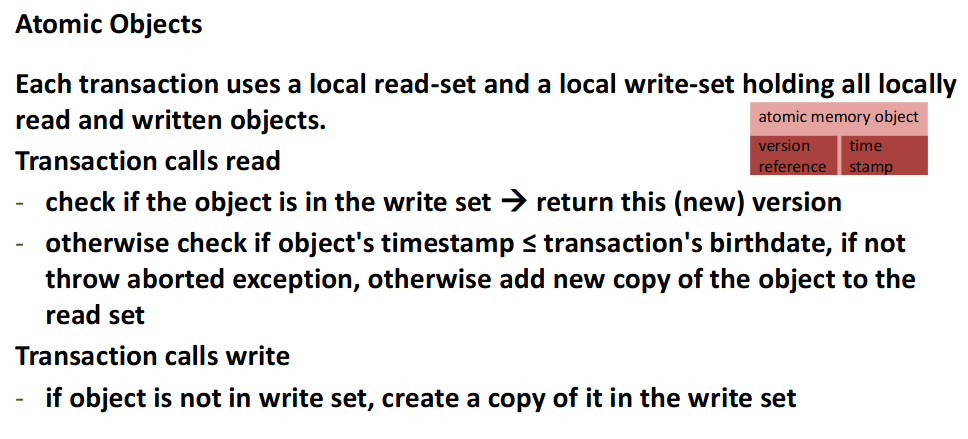
**Read obj:
- Check thread’s local write-set first. If found, return buffered value.
- this gives us isolation
- Otherwise, check
obj.timestamp <= tx.birthdate. If not, the object was modified after the transaction started → conflict → abort transaction. - If timestamp is okay, read the object’s committed value
- add
objto the read-set.
- add
Write obj:
- If
objnot in write-set- create a private copy in the write-set (write buffering).
- From now on: update the private copy.
Example:
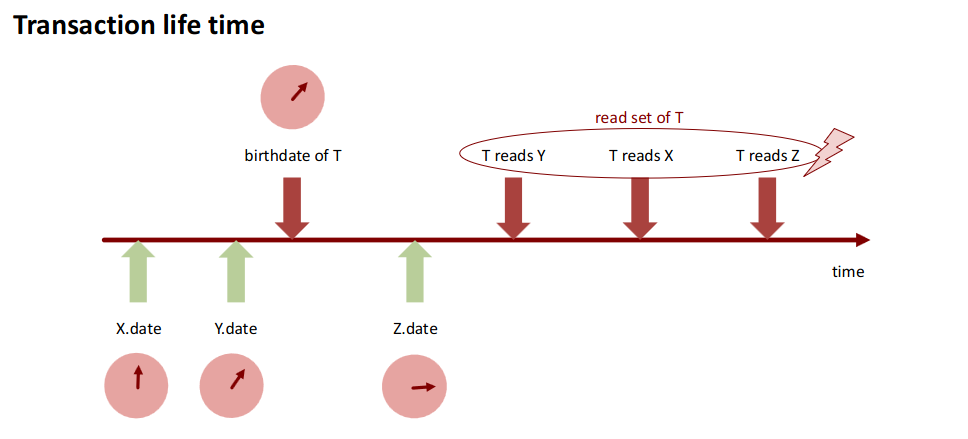
In this example, Z’s timestamp T’s birthdate, thus we must abort → this is because Z was written after T started
- serializability violated
Commit
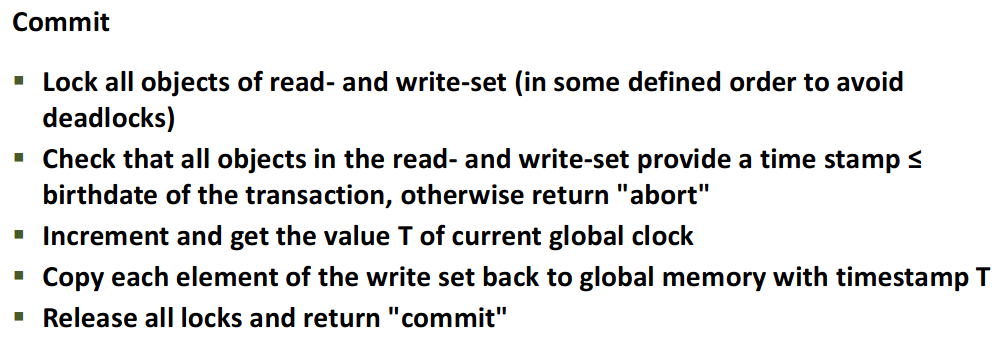
- Acquire commit lock (simplest CC)
- Validate read-set:
- For every
objin read-set, checkobj.timestamp <= tx.birthdateagain- → checks for conflicts that occurred during execution
- If validation fails, abort.
- For every
- If valid, increment global clock.
- Update timestamps of all objects in the write-set to the new clock value.
- Write buffered values back to main memory
- Release commit lock.
There are two possible execution paths:
- Successful commit
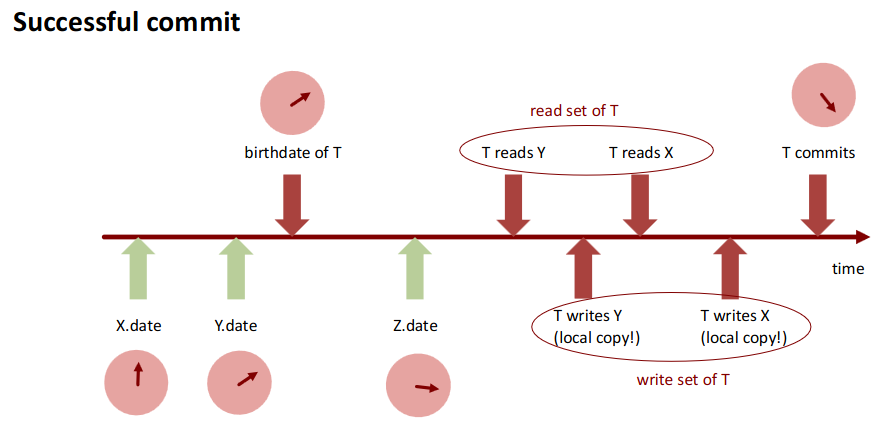
Because we don’t modify / readZ, we can commit without issue. - Aborted commit
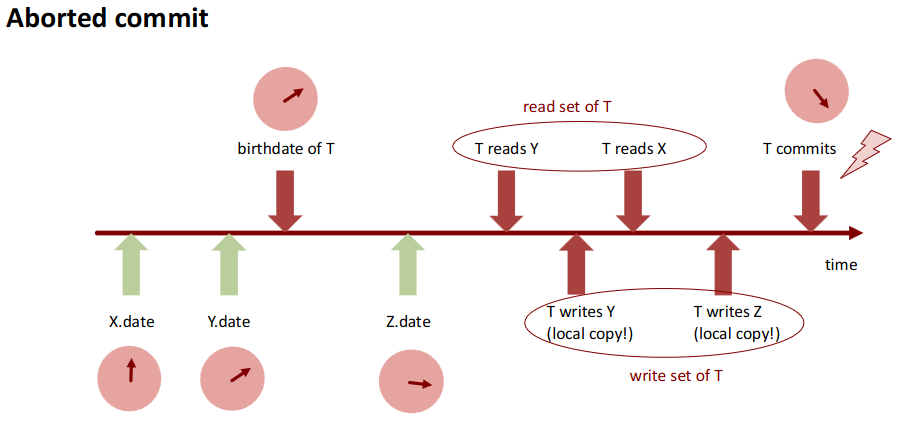 The issue with the timestamp of Z birthdate is detected during the commit.
17.6 Dining Philosophers using TM
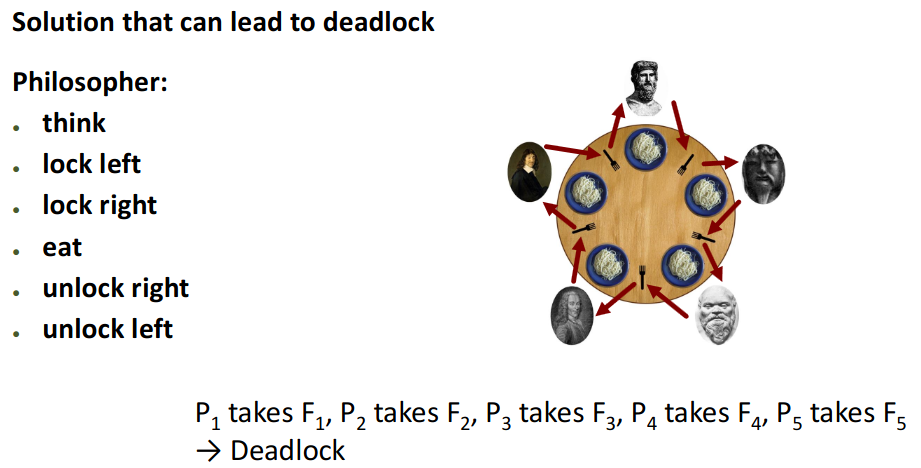
Implementation with TM:
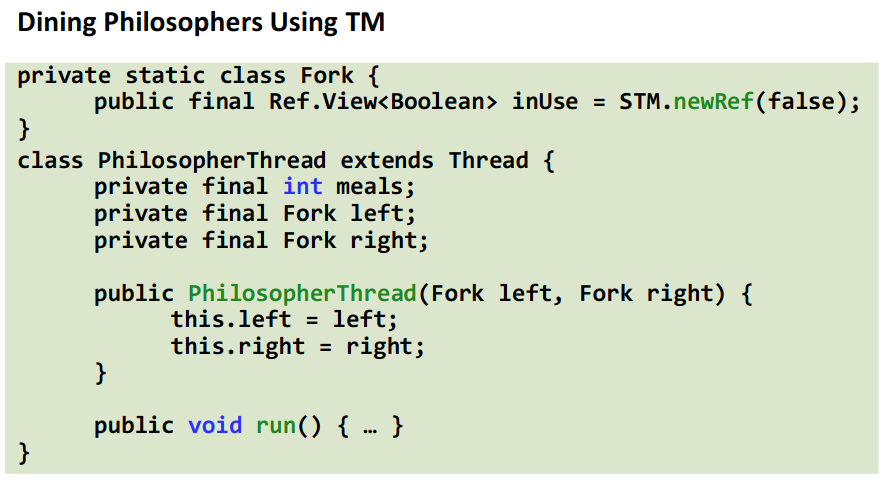
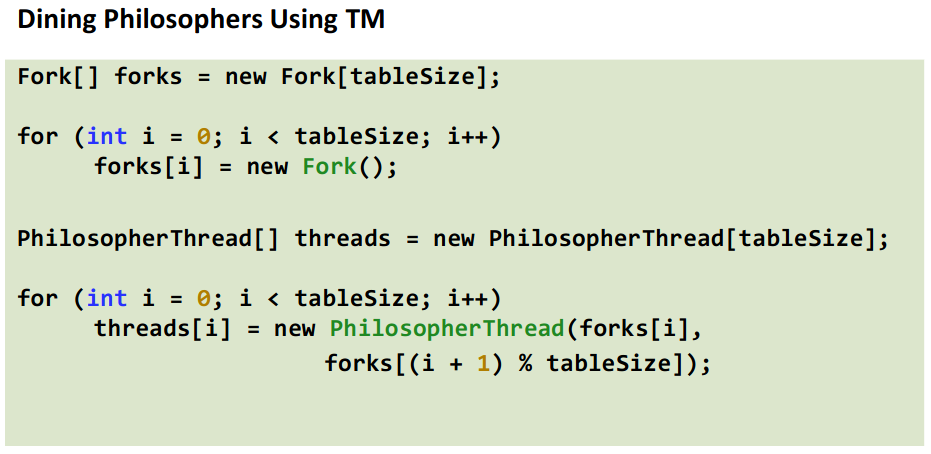
Methods for actually atomically taking / putting down forks
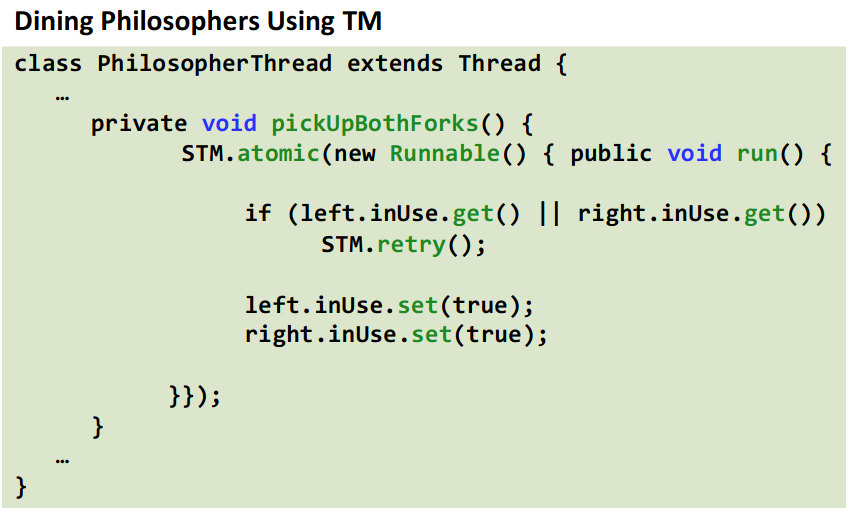
We use the retry() function to get re-run when the left/right forks are updated.
- automatically wake the thread and re-run the function when something changes
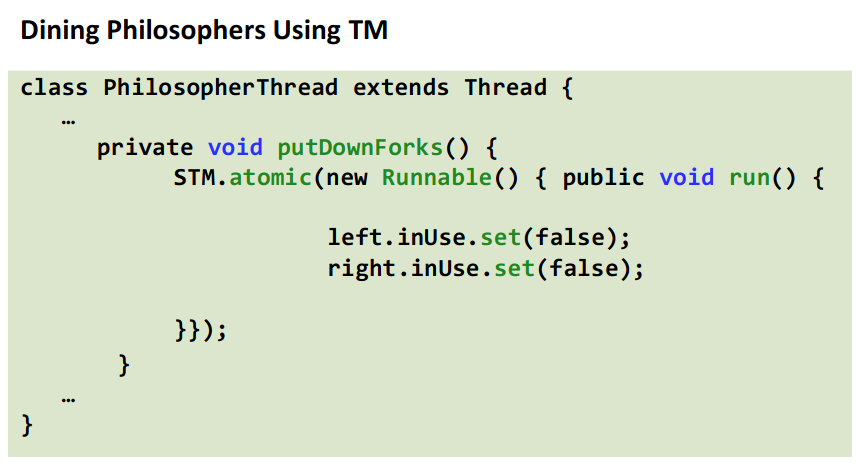
The programmer simply sattes their atomic requirements
- issues with deadlock, etc… automatically handled by the STM system and the retry mechanism.
17.7 Issues
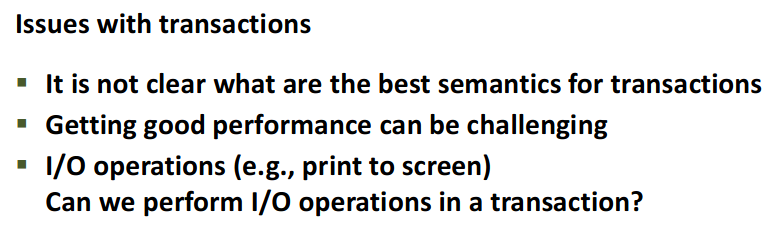
Semantics:
- there is no universal agreement on what the best semantics are
- flattened vs. closed vs open nesting
- isolation levels, etc…