Managing Risk & Understanding Options
1 Why Manage Risk?
Risk management doesn’t always add firm value. Two reasons it may not:
- Hedging is a zero-sum game — gains cancel losses across counterparties.
- Investors can hedge themselves (DIY alternative), so firm-level hedging is redundant.
Still, firms face real risks that justify hedging: cash shortfalls, financial distress, agency costs, FX fluctuations, political instability, weather.
2 Insurance
Insurance
Transfer of a firm’s non-diversifiable hazard risk to an insurer (or risk pool). The expected loss is shared across many policyholders; each pays a proportional premium.
Example: \1\text{bn}1/10{,}000$ storm risk per year. Expected loss per member of a 10,000-firm pool:
An insurer won’t necessarily offer this at \100\text{k}$ because of:
- Administrative costs
- Adverse selection — riskier firms are more likely to buy insurance
- Moral hazard — insured party takes more risk
Correlated losses (e.g. all platforms in the same region) amplify the insurer’s true exposure far beyond any single firm’s probability.
Catastrophe Bond (CAT Bond)
A bond whose coupon/principal payments are reduced if industry-wide (or issuer-level) insurable losses exceed a threshold. Allows insurers to transfer tail risk to bond investors.
Moral hazard note: Issuer-level triggers incentivize overcommitment to high-risk books; industry-level triggers do not.
3 Options
Option
A contract giving the holder the right (not obligation) to buy or sell an asset at a specified exercise price (strike) within a specified period, for a premium.
- Call option: right to buy
- Put option: right to sell
- American: exercisable any time up to expiry
- European: exercisable only at expiry
Payoff profiles (ignoring premium):
| Position | Payoff at expiry |
|---|---|
| Long call | |
| Long put | |
| Short call | |
| Short put |
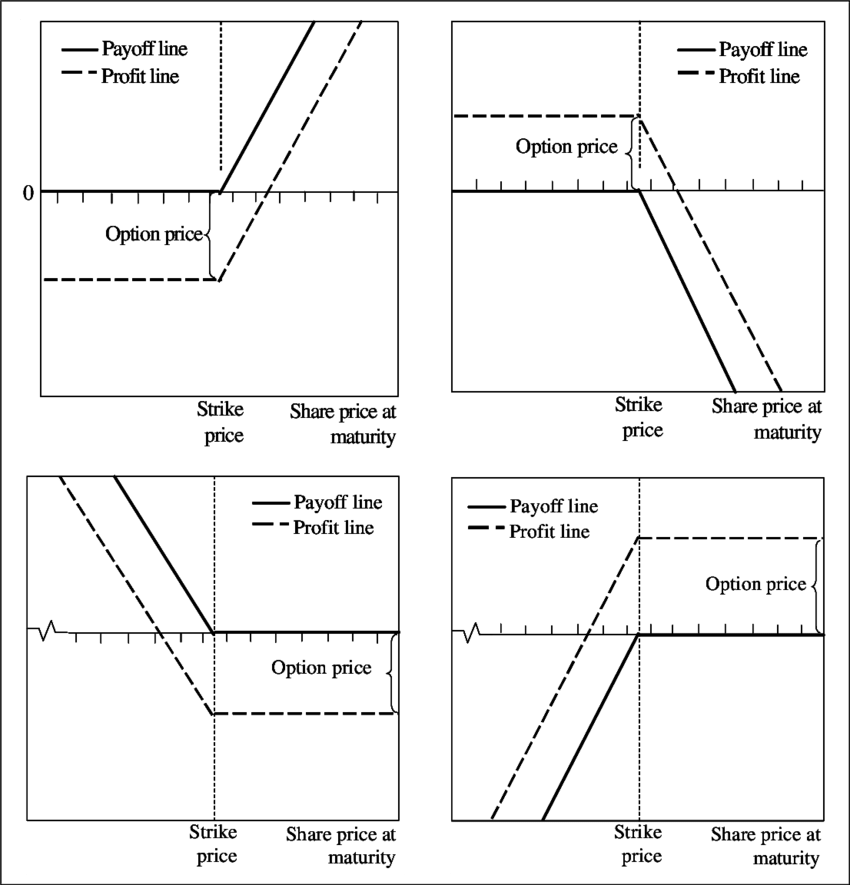
The seller of a call faces unlimited loss potential — they must deliver at regardless of how high rises.
**Example (Amazon, Jan 2020, S_0 = \1{,}830K = $1{,}830$146.20$1{,}830 + $146.20 = $1{,}976.20$.
3.1 Reducing Risk with Put Options
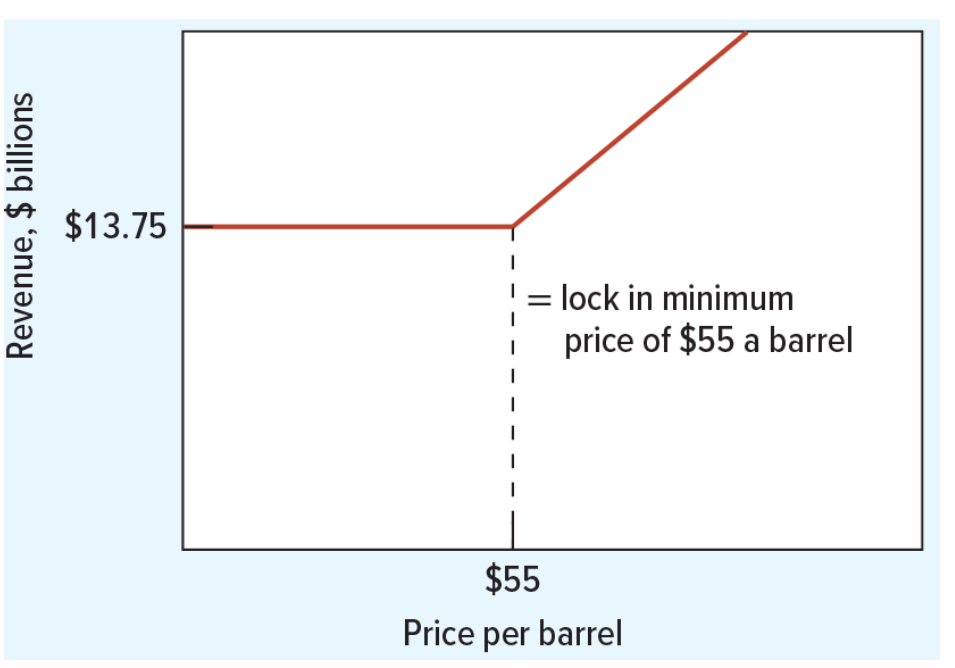
An oil producer selling 250M barrels can buy put options (strike K = \55$13.75\text{bn}$. Revenue profile:
- If S_T < \55$55$13.75\text{bn}$
- If S_T > \55$: sell at market, upside retained
4 Forward & Futures Contracts
Forward Contract
A bilateral agreement to buy/sell an asset at a specified price on a specified future date. Traded OTC; settled at maturity.
Futures Contract
Like a forward, but exchange-traded and marked to market daily. Gains/losses settled continuously.
Basis risk: arises when the hedging instrument is not perfectly correlated with the asset being hedged.
Example (Arctic Fuels/Northern Refineries): Arctic (short on oil) and Northern (long, producing oil) enter a forward at \2.40$/gallon for 1M gallons in January. Both lock in price regardless of spot moves. Each creates an offsetting position to their natural exposure.
4.1 Pricing Financial Futures
For equity index futures:
where is the risk-free rate and is the dividend yield.
Example (CAC, 6-month): , , :
4.2 Pricing Commodity Futures
Net Convenience Yield (NCY)
The net benefit of holding the physical commodity vs. a futures position. When NCY , futures trade below spot (backwardation). When NCY , futures trade above spot (contango).
Example (WTI, Feb 2022): S_0 = \124F_{1\text{yr}} = $92.50r_f = 0.3%$:
Market in backwardation — immediate scarcity from Ukraine invasion expected to ease over time.
5 Interest Rate Risk
Forward Interest Rate
The rate agreed today for a loan starting in the future, implied by the yield curve:
Example: , :
This can be synthetically locked in by borrowing for 1 year at 10% and lending for 2 years at 12%.
6 Swaps
6.1 Interest Rate Swaps
Interest Rate Swap
An agreement where one counterparty pays fixed cash flows and receives floating (or vice versa) on a notional principal. No exchange of principal; only net interest payments flow.
Example (5-year fixed-to-floating, 6% vs SOFR, notional \66.67\text{m}$):
- Year 1: SOFR → bank pays \4\text{m}$3.33\text{m}$0.67\text{m}$
- Year 2: SOFR → net payment
At creation, swap NPV . If rates subsequently rise to , the PV of three remaining \0.67\text{m}$ net payments is:
6.2 Currency Swaps
Currency Swap
Exchange of fixed cash flows in one currency for fixed cash flows in another. Allows a firm to issue debt in a familiar market and swap the proceeds into the desired currency.
A currency swap works as follows:
- exchange principals (A gives 3M CHF to A) at a fixed exchange rate (day spot price)
- Pay interest over duration of loan (at daily rate)
- Exchange principles back (at original rate) → independent of current spot price
Thus there is no risk of price moving anymore.
Example (Possum Co.): Issues \10\text{m}$ USD notes at 6%, swaps into EUR 8m at 5%. Net cash flows are entirely in EUR — FX exposure eliminated.
7 Setting Up a Hedge
7.1 Duration Matching
To hedge interest rate risk on a fixed-income asset, issue offsetting debt with the same duration, not just the same PV.
Example (Potterton Leasing): 20-year annuity lease, \2\text{m/yr}r = 10%= 7.5$ years:
If interest rates rise → PV goes down - your asset (2M a year. If rates rise, that money is “worth more” i.e. you can get more from it. Whereas your repayment is still fixed 2M for loan. (Opportunity cost!)
But Issuing \17\text{m}\approx 0$.
7.2 Hedge Ratios & Basis Risk
To hedge Asset A using Asset B, sell units of B per unit of A:
(the hedge ratio) is estimated by regressing historical price changes of A on B. Residual unhedged risk is basis risk.
Example (wheat farmer): Regression of farmer’s price on Kansas City futures gives → sell 0.8 futures contracts per unit of wheat held.
I.e. wheat futures are not perfectly correlated to the wheat price the farmer actually gets.
8 Derivatives & Speculation
Speculators are attracted by the leverage derivatives provide, and their participation helps keep markets liquid. However, speculative positions can cause large losses. Two precautions:
- Monitor positions regularly — don’t be taken by surprise.
- Only speculate when you have a comparative advantage (informational edge) that puts the odds in your favour.