Cash-in, Cash-Out and Working Capital
Example:
- pay out extra $10M in cash dividend
- decreases cash by $10M
- decreases WC by $10M
- Receive $2.5k from customer (from previous sale)
- increase cash by $2.5k
- no change (was already under receivables)
- Pay $50.0k previously owed to suppliers
- decrease cash
- but was already booked under current liabilities → balances out
Working Capital Management
Working Capital is the difference between a company’s current assets and current liabilities.
Working Capital Requirement
operational concept → how much capital a business needs to tie up to fund it’s operating cycle (gap between paying for inputs and receiving payments from customers)
which simplifies to
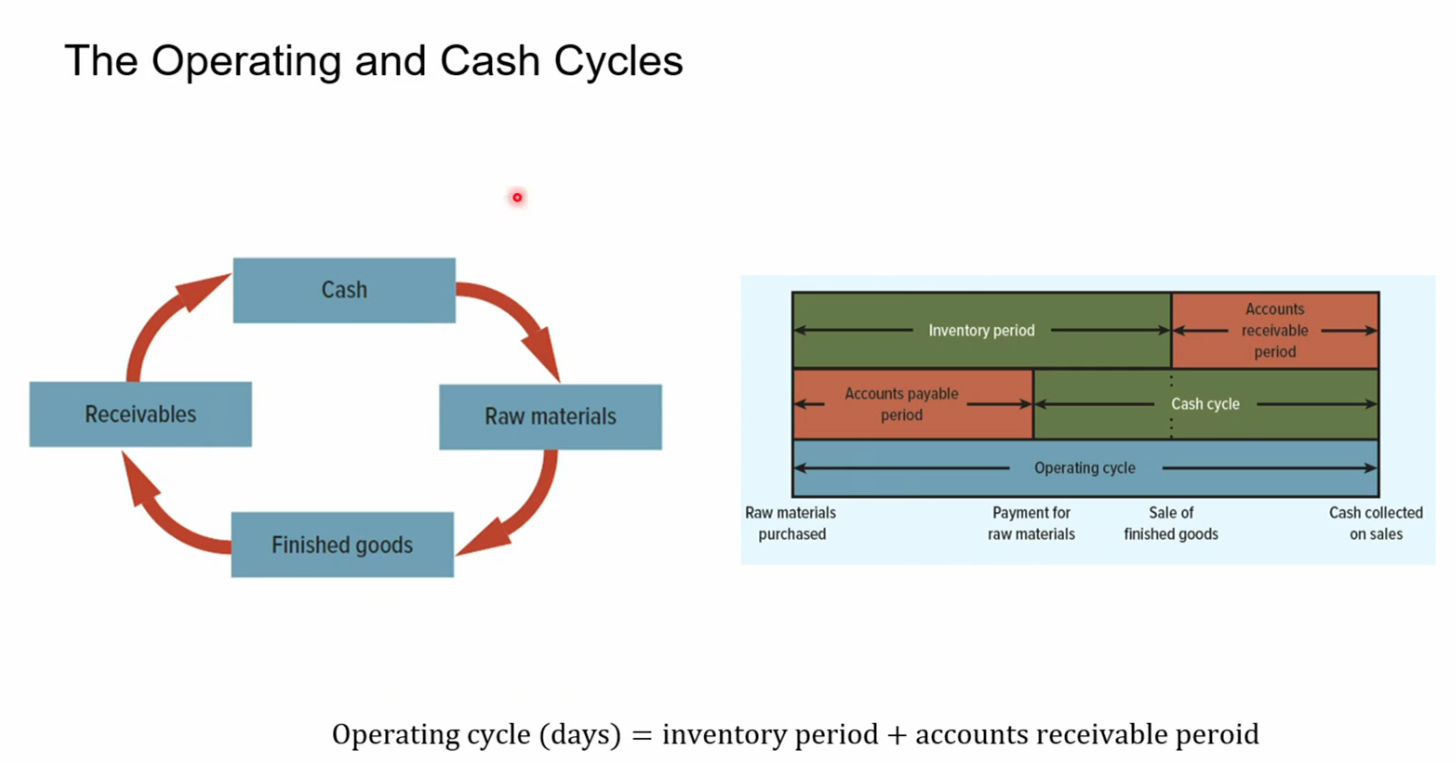
Operating cycle: total time
Cash Cycle
cash cycle = inventory period + accounts receivable period - accounts payable period
measures how long it takes for a company to convert it’s cash investments in inventory back into cash from sales.
= net number of days your own cash is locked up in the operating cycle
Interval between firm’s payment for raw materials and collection of payments from customers (i.e. the time they’re out of cash).
- average inventory period =
- average receivables period =
- average payment period =
Important KPI (amazon has had negative CC for years → collect from customers before you pay suppliers)
Link to WCR
The CashCycle and WCR are two sides of the same coin:
- WCR = how much cash is tied up in the cycle (a stock, in €/$)
- CCC = how long cash is tied up in the cycle (a duration, in days)
You can derive WCR from CC: WCR = Revenue x (CC / 365)
- daily revenue = revenue / 365
- how long that cash is tied up
if revenue doubles → WCR also doubles → too much cash tied up / increases cash requirements
Example Effects on the Cash Cycle
-
Customers are given a larger discount on cash transactions
- Effect: CCC shortens ↓
- A discount incentivizes customers to pay immediately (cash) rather than on credit. This reduces the receivables period (DSO) — you collect cash faster instead of waiting 30, 60, 90 days.
-
The firm adopts a policy of reducing accounts payable
- Effect: CCC lengthens ↑
- Reducing accounts payable means the firm pays its suppliers sooner (or takes on less payable balance). This decreases the payables period (DPO).
Inventories
- raw materials
- work in progress
- finished goods (should be empty → sold to clients)
Goal → minimise cash tied up in inventory
Tools to minimise inventory:
- just in time
- order size:
- increase order size → order number falls (more per order) → order costs decline
- however: increase in order size → increase average inventory amount
- strike a balance
- increase order size → order number falls (more per order) → order costs decline
Financial Planning
Free-Cash-Flow Model
Operating Cash Flow = Depreciation + After-tax interest + Net income
Note we add After-Tax interest back because FCF is computed assuming all equity financing
FCF = operating cash flow - CapEx
- CapEx = investment in fixed assets
- we also include Investment in working capital as CapEx
model for valuation that estimates the value by forecasting how much cash it generates after accounting for capex, then discounting those cashflows back to today.
Planning
Plan for at least 5 years, accurate forecasting
But not too deep into details, it’s “art”
Horizon Value Model
Given a “horizon value” of a firm, say 10x the earnings in 2026 under all equity financing, we can calculate the PV
PV = (FCF year 1) / cc^1 + (FCF year 2)/ cc^2 + … over the years + (FCF year t + Horizon value) / cc
where FCF is the free cash flow of that year and cc is the cost of capital
Accounts Receivable Management
- Trade Credit: Receivables from one company to another
- Consumer Credit: receivables from customers
Five questions for management
- How long time for customers to pay bills?
- Prepared to offer Cash discount for prompt payment?
- How do you determine which customers likely pay their bills?
- How much credit are you prepared to extend each customer? (play it safe vs. risk acceptance)
- How do you collect the money when it comes due?
- what about reluctant payers or deadbeats?
Terms: ex: “2/10 net 31”
- 2: percent discount for early payment
- 10: number of days discount is available
- 31: days until the bill is due (no discount)
Credit Analysis: determine likelihood customer pays their bills
- credit agencies (Dun and Bradstreet is largest one)
- financial ratios
- ask bank for a “credit check” on your customer
Credit Policy: standards set to determine the amount and nature of credit to extend to customers
Credit Scoring: What your lender won’t tell you
- extending credit gives you probability of profit → not guarantee
- still a chance of default
- denying credit guarantees neither profit nor loss
Collection Policy: procedures to collect and monitor receivables
Factoring: Arrangement whereby a financial institution buys a company’s accounts receivable and collects the debt
When to pay
If you have 5/10, net 60 and you decide not to take the discount, what interest rate are you getting on your loan.
effective annual interest = (1 + )^{365 / extra days credit} - 1
so in our case = (1 + 5/95)^{365/50} - 1 = 45.4%
When to grant credit
If the expected gain from granting credit > 0
EV = p * PV(REV - COST) - (1 - p) * PV(COST)
customer pays with prob p and defaults with probability (1 - p).
But if there is the chance of repeat order → you might lose good customer if you don’t offer credit
- if margin of profit is high → easier to give credit
- otherwise, be sparing
You can also outsource the collection to a factor, which is a business that just deals with getting paid. You may even get 70-80% of the order value financed in advance, with pre-agreed interest.
Cash Management
→ cash does not pay interest
- Move money from cash into short-term securities
- usually less than one year notes
- “sweep programmes”
- pooling
Forecasting cash needs
- Forecast sources of cash
- largest usually payments by firm’s customers
- Forecast the uses of cash
- Calculate whether the firm is facing cash shortage or surplus
- either raising or investing cash
for 1, we need to see how long on average until customers actually pay their receipts → until then the receipts are not cash but assets receivable
for 2, estimate payments of accounts payable, increase in inventory, labor/admin costs, capex and taxes
for 3, we take the difference to calculate how much extra cash we need from short-term loans
to do this, see:
Developing a short term financial plan
we can either:
- bank loan (borrow money)
- stretching payables (put off payments of bills)
→ stretching payables is often costly (even if no ill-will) as suppliers may offer discounts for prompt payment
ex: if 5% discount is lost and we pay next quarter = equivalent to annual loan at 20% interest rate (4 * 5% = 20% → usually would need geometric average but it’s short enough).
Pitfalls: the models should be adjusted to account for fixed costs, depreciation and taxes, etc…
- percent-of-sales methods ignore the existance of fixed costs
- many models ignore depreciation and taxes
- models generally produce accounting numbers rather than financial cash flows
Money Market Investments
You say that a x-month bill is issued at a y% discount.
This means that the price (in %) is p = 100 - (x/12) * y.
To annualise, you then do (100 - p) / p which gives you the x month rate. Then you do .
Extra
External Capital Required
(CFO = cash flow from operations for planning)
- Increases in receivables USE cash;
- decreases in inventory RELEASE cash;
- increases in payables RELEASE cash.
External capital required = ΔNWC + ΔFixed Assets + Dividends − CFO
Operating CF
Operating CF = Depreciation + After-tax interest + Net income
FCF = OCF - Investment working capital - investment fixed assets
Sustainable Growth Rate & Plowback
Plowback ratio = retained earnings / net income
proportion of net income that the company retains and reinvests back into the business → rather than paying out dividends
SGR = plowback * ROE
→ Maximum growth rate the firm can maintain without increasing leverage
Internal Growth Rate The maximum growth rate a firm can achieve using only retained earnings — no external financing at all.
The SGR is the maximum growth rate achievable while maintaining a constant debt/equity ratio.
EOQ
Economic Order Quantity: Order quantity that minimises total inventory costs → balances orders against holding costs
EOQ = √[(2 × 10,000 × 50) / 4] = √250,000 = 500 units.
Banker’s Acceptance
A bankers’ acceptance is an unconditional promise of a bank to make payment on a
draft when it matures.
The acceptance is in the form of the bank’s endorsement (“acceptance”) of a draft drawn against that bank in accordance with the terms and conditions of a letter of credit issued by the bank.
→ the bank is essentially an escrow, but a “tradeable asset” gets created here
These are traded at a discount.
→ pays fixed value at maturity
- because not matured, investors buy it for PV
Bankers’ acceptances have their origin in international trade transactions.
→ Cross-Border trade
- seller ships goods but is afraid bank won’t buy
- buyer pays but is afraid seller won’t ship
- → bank assures, and seller can even sell the BA on the market to get money immediately