Spin-Off
Holcim spun off it’s North-American business to create a new and independent, publicly traded company called Amrize.
- one amrize share per holcim share held
- amrize listed at NYSE and Swiss stock exchanges
Reasons:
- pure focus on north-american customers → decentralised business model
- cement is not transported, produced locally and so they operate locally
- pure US$ based, tailored capital structure
- environmental regulation in US vs. Europe → too big a difference
- Create a distinct investment profile for investors
- have choice to invest only in US
- main factor
- EV / EBITDA ratio was worse for Holcim than US peers
- means that EV / EBITDA ratio can be better in US
- Also increased EV / EBITDA in the Europe
- EV / EBITDA ratio was worse for Holcim than US peers
Spin transaction → separate 1 share into 2
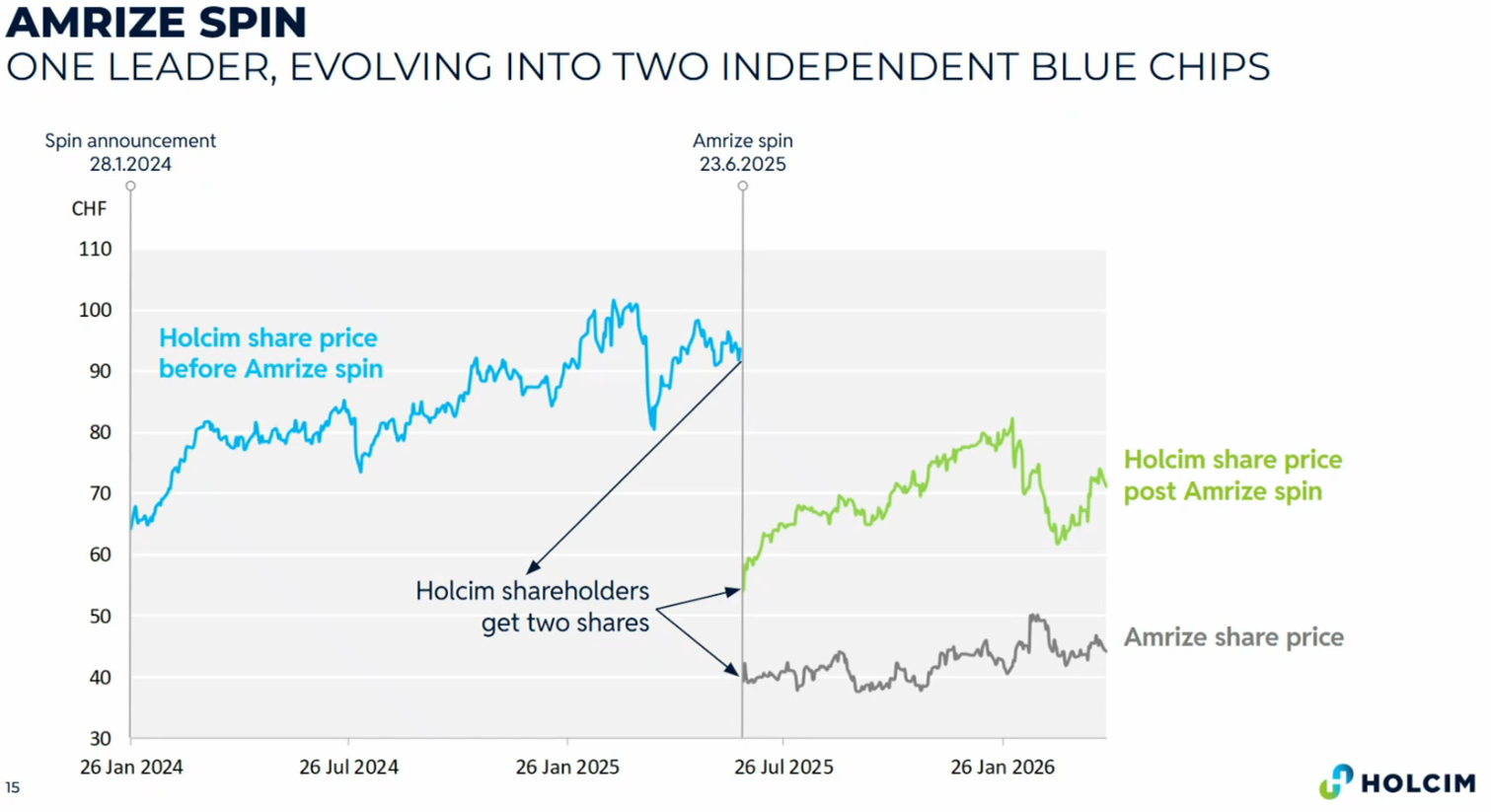
- holcim valuation dropped → US business is out
(different slide) If you take out amrize share value historically, you can see big increase in value when amrize spin was announced and executed +132.5%
How to separate the business
Spin out the business, want to separate the debt ($8.4 bn) from Holcim into Amrize.
- there were bonds, you cannot simply move them
- amrize (North american business) had debt against holcim
So, two transactions
- Amrize raised new bonds (for $3.4 bn) on 2. April 2025
- injected in 4 tranches (2, 3, 5, 10 year maturity)
- this was supposed to pay back the debt to Holcim
- Bond exchange
- offered choice to bond investors: want to stay with holcim or move to amrize
- done before spin
- par-for-par exchange to transfer certain USD bonds to Amrize
- Fall-away guarantee from holcim that falls away upon successful spin closing
- offered choice to bond investors: want to stay with holcim or move to amrize
Other treasury activities
- secure liquidity
- bridge facility (financing to cover bond exchange and issuance)
- ensure amrize has liquidity for daily ops, 2bn
- revolving credit facility
- commercial paper program → issue commercial papers (short term)
- secure rating
- rating evaluation / assesment with S&P and Moody’s to determine the upper and lower threshholds for BBB+/Baa1 credit ratings for Holcim pre- and post-Amrize spin
- Treasury team
- build new team that is operational from day 1
How to Issue a bond
First: Detailed cash planning to understand what you need.
Understand cash-”opening” here → what you start off with and then “cash-closing” what is left.
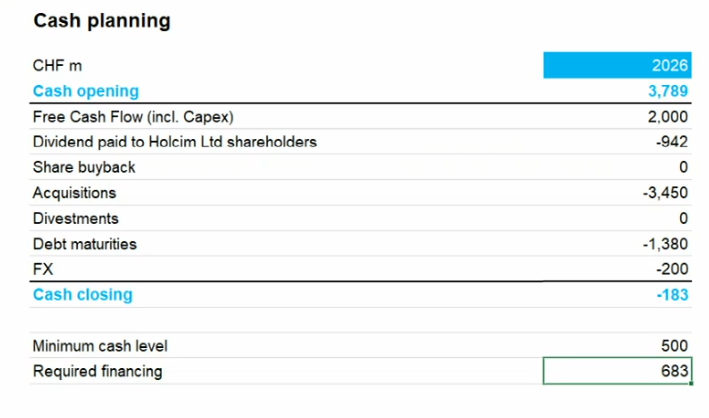
Then you are left with 683M to get to the $500M minimum (set arbitrarily).
How do you place such a bond?
- do not have a “peak of bonds”, keep the distribution even!
- distribute currency even
This is the distribution → $1bn per year maturing is “reasonable” for them
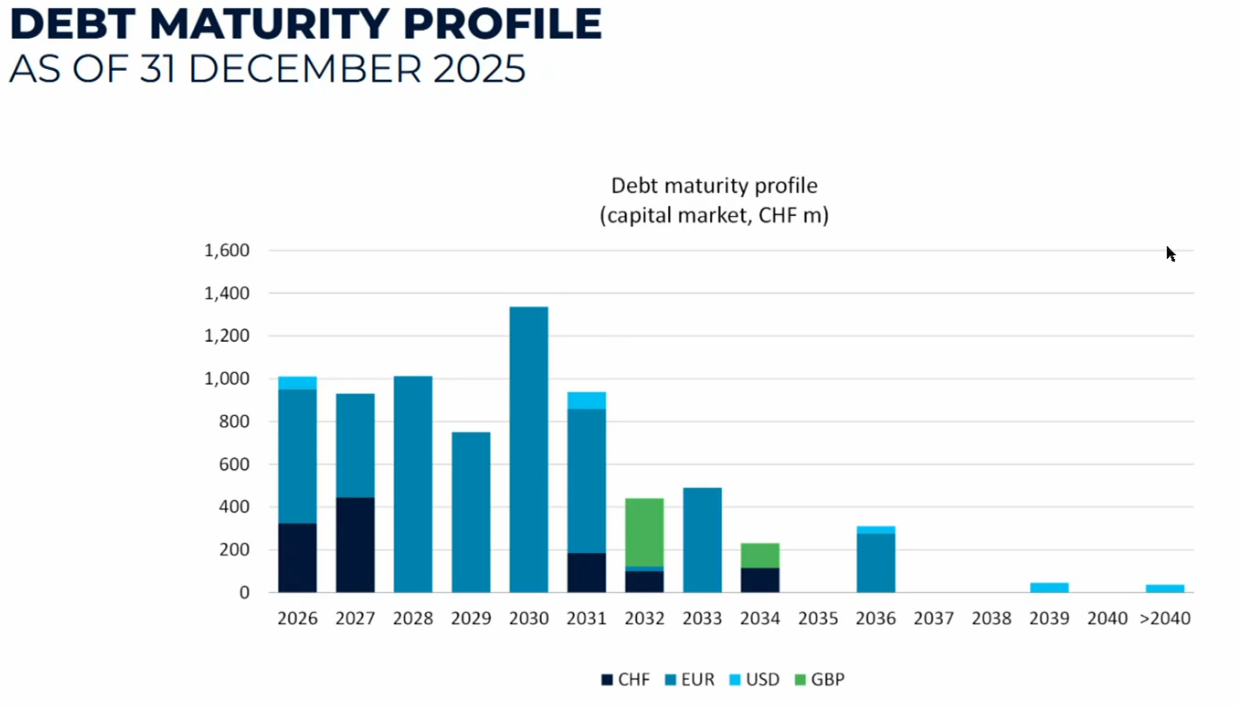
A large part of Holcim’s balance sheet is from Capital Markets → not from banks but bonds. The average bond maturity is 7 years.
- longer maturity → lower refinancing risk
- lengthening maturity profile in low interest rate periods
- → reduce interest expenses in high-interest periods
- long maturities not always available (especially for lower rated companies)
Bond Pricing:
- priced with “spread” above government bond yield
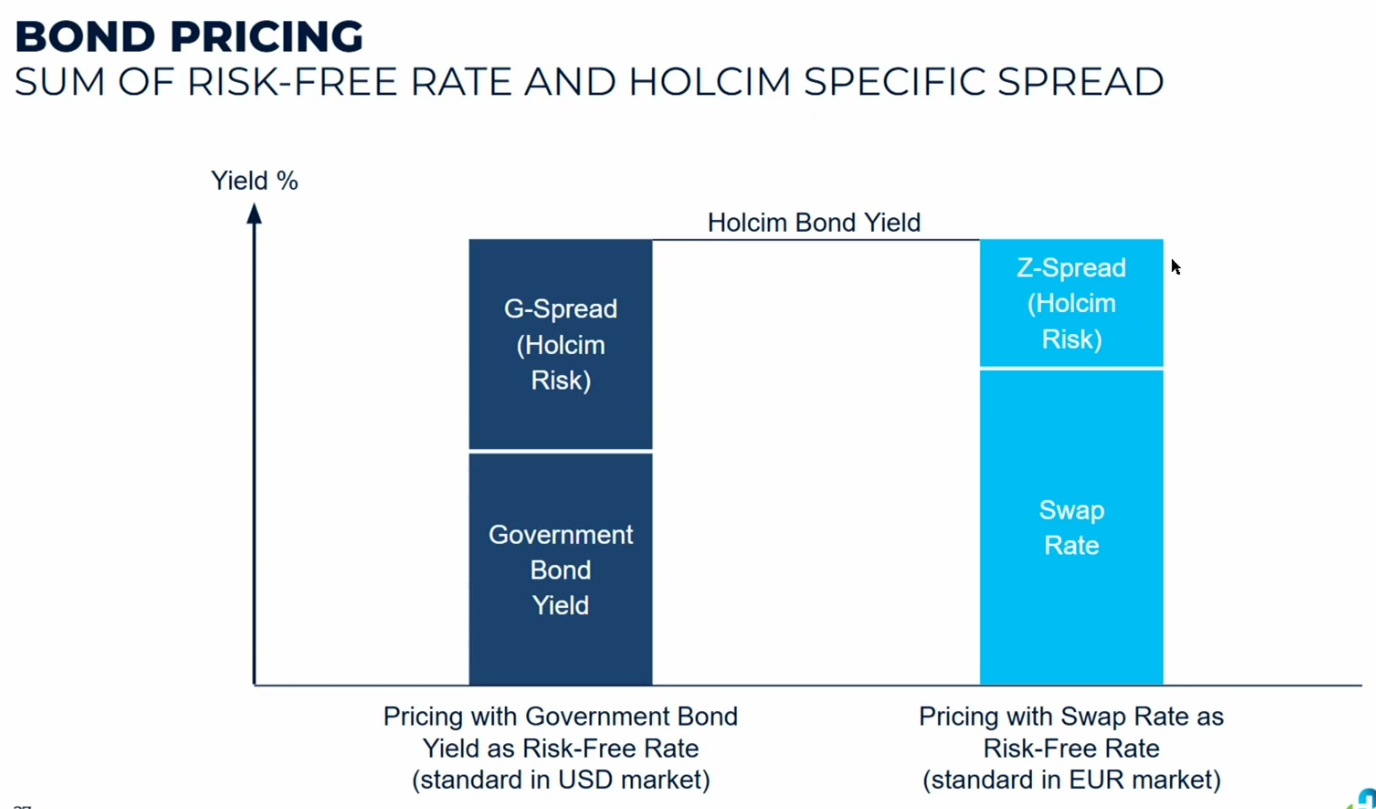
Re-offer Yield
The re-offer yield is the yield-to-maturity at which an underwriting bank sells (“re-offers”) a newly issued bond to final investors. It is set as
where the swap rate is the risk-free benchmark and the spread compensates investors for the issuer’s credit risk.
The swap rate is the risk-free rate and spread is the “extra” on top investors demand.
- swap rate = paying this rate fixed per year for X years is fair exchange for receiving floating short-term rates (SOFR/LIBOR) for the same X years
- the fixed rate you receive in exchange for giving up your floating payments
- Note, it’s not risk-free because of no risk → rather because it’s the “naked” lending rate between banks → void of any risk calculations
Re-offer Price
The re-offer price is the price per 100 face value that investors pay. It is mechanically derived from the re-offer yield — the unique price at which the discounted cash flows equal the investor’s required return.
= PV of all cashflows, discounted at re-offer yield
The two are not independent: given the yield, there is exactly one consistent price.
Example: Holcim issued a CHF 475m, 6-year bond on 7 June 2010 with a 2.375% annual coupon, a swap rate of 1.403%, and a spread of 105 bps.
- The re-offer yield is .
- The re-offer price is the present value of all cash flows discounted at this yield: .
→ We discount at re-offer yield because it is the investor’s required return
- Since the coupon (2.375%) < required return (2.453%)
- bond trades at a small discount below par: investors pay less upfront to make up for the below-market coupon
No investor would buy a “fresh” bond at 80bps → if there are already bonds trading on the market for that rate
- so you have to give a slight discount to attract capital