8.1 Hauptsatz der Integral- und Differentialrechnung
8.1.1 Der Hauptsatz (The fundamental Theorem of Calculus, FTC)
7.1 Primitive
Let be an interval and . A differentiable function with is called a primitive (or antiderivative, Stammfunktion) of .
Note: A primitive need not exist: by Darboux’s theorem, no differentiable satisfies for example.
7.2 Fundamental Theorem of Calculus
Let be continuous. Then:
- For every , the function
is a primitive of .
2. Every primitive of has this form for some constant .
7.3 Unterteilung des Integrationsbereichs
Es seien . Sei eine auf integrierbare Funktion. Dann gilt
Proof: (FTC) continuous thus integrable.
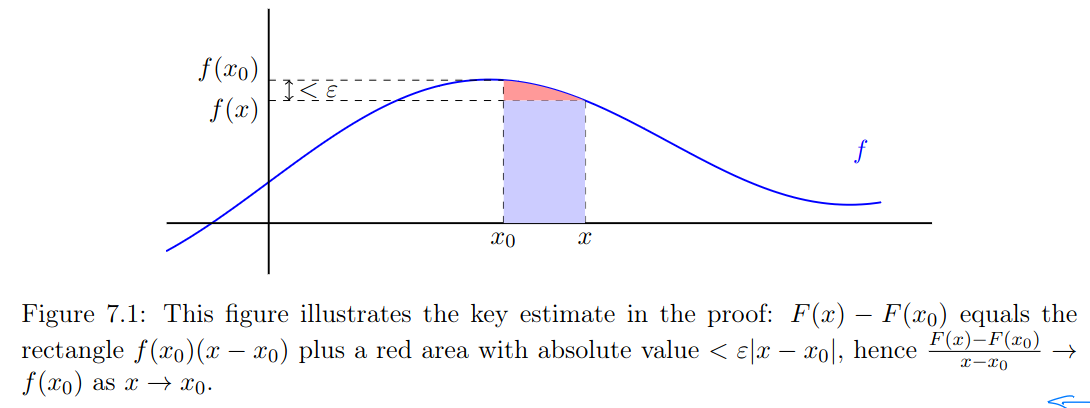
- Fix and we want to show .
- Fix ; by continuity there is with
- For , using
	- since $t \in [x_0, x] \subset [x_0, x_0 + \delta)$ forces $|f(t) - f(x_0)| < \varepsilon$ by continuity
- The case $x \in (x_0 - \delta, x_0)$ is symmetric. Hence the difference quotient converges to $f(x_0)$, i.e. $F'(x_0) = f(x_0)$.
2. Let be any primitive. Since by (i)
so is constant on .
7.4 Piecewise continuous derivative
Es sei bis auf endlich viele Ausnahmestellen auf stetig. Dann ist
bis auf die Ausnahmestellen auf stetig differenzierbar mit ,
7.5 Integral vs. Derivative
If is continuously differentiable, then for all
Proof: Since is a primitive of , the FTC yields . Evaluating at yields .
Riemann Integral and Primitives
If is continuous and is a primitive of , then
Proof: follows trivially from 7.5 with and .
8.2 Integrationstechniken
We write , with the convention .
8.2.1 Partielle Integration
Integration by Parts
If are continuously differentiable, then
Proof: From , rearranging and integrating via the previous corollary
8.2.2 Substitution
Integration by Substitution (1st Form)
Let be intervals, continuously differentiable, continuous. For ,
Proof: Fix and set , so . By the chain rule . Integrating and applying the corollary
Integration by Substitution (2nd Form)
Let be intervals, be , continuous. Let with on , and let be the inverse of . Then
Note: if is with , then has constant sign.
- So is strictly monotone (via MVT) and invertible;
- is continuous and differentiable
- , which is again continuous.
- Differentiate
- .
Proof: Write
- apply the 1st form with in place of :
- and .
Example: with and . Because there’s no factor to be seen, we use substitution part 2.
- and .
8.3 Improper Integrals
A function is locally integrable if is integrable for every compact .
Improper Integrals
Let be a nonempty interval and be locally integrable. Set and and fix a .
We define the improper integral of on bywhenever both limits are well-defined (no indeterminate form ).
If the values are finite, we say the integral converges, otherwise it does not converge.
Note: when defined, the value is independent of the choice of !
Example: Integral of over the interval . The function is continuous and hence locally integrable, but unbounded near , so not integrable on in the usual Riemann sense.
where and thus it evaluates to . Thus the improper integral diverges to .
7.19 Integral Test for Series
Let be monotone decreasing. Then for every
and in particular
Example:
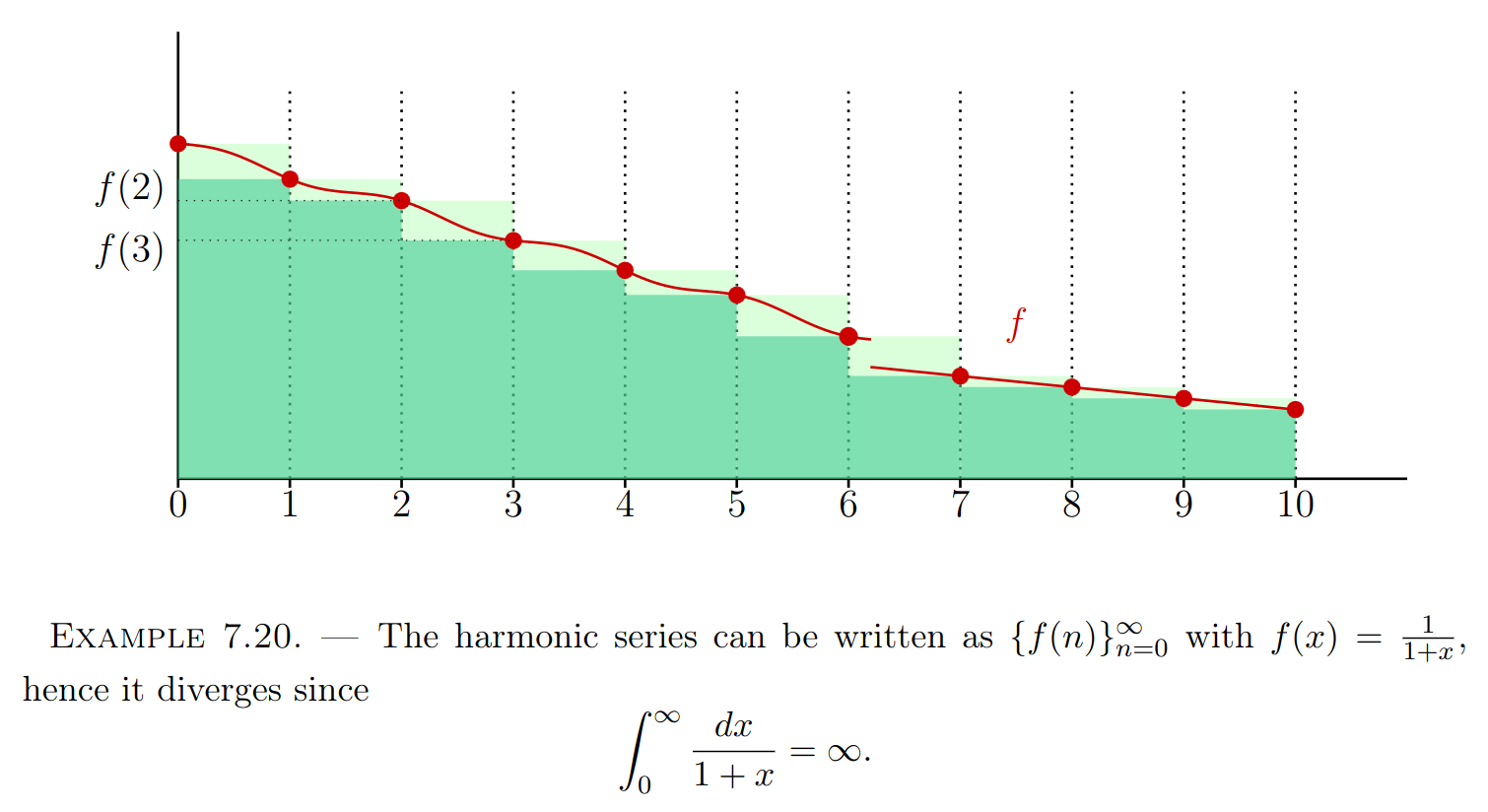
in particular we can use this inequality to bound the partial sums of the harmonic series. We can see where the factor comes from now!
8.4 Leibniz Integral Rule
Leibniz Integral Rule
For an integral of the form
where the derivative is expressible as
Tips & Tricks
Use Euler instead of Trig identities
Instead of knowing that , we can also expand and integrate this, which is much easier!
Substitution
For substitution we use the fact that
you massage the function into looking like that and replace all occurrences of the with .
Then you get and solve to get .
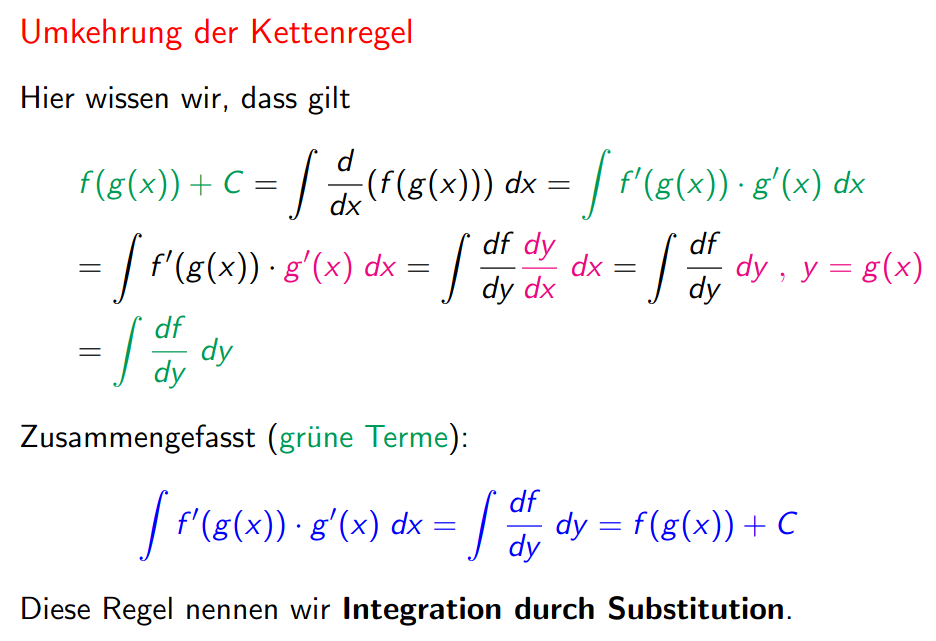
Here we clearly see:
- rewrite . Then .
- as we derive with regards to , our new !
We know (intuitively: small change in u = slope of g at x + small change in x → we replace inside ).
Notice we can also do it the other way round: We have but also .
Instead of replacing by we can also insert the derivative:
Ex: substituting . Then and :
then using polynomial division which gives .
With bounds
→ Watch out for bounding, as often is required. Then we have not .
Trigonometric
Here we replace by to use trig identities. Then we get .