6.1 Registers
The register naming convention has a long history, explaining the confusing names.
The 8086 had only 16 bit registers, with some split into 8 and 8 (like accumulate, counter).
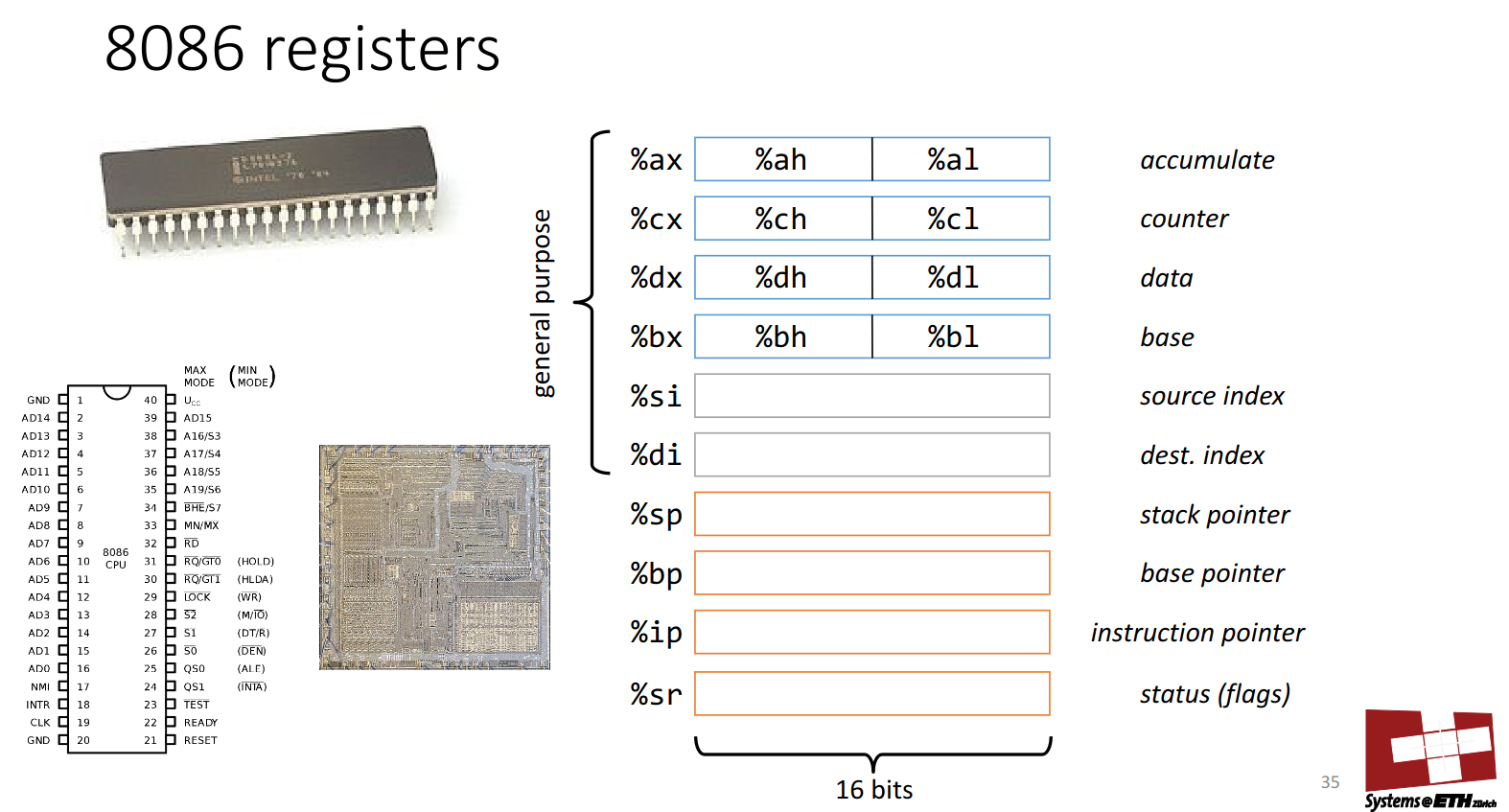
When we went to 32 bits, Intel just expanded the names, calling them “extended-accumulate” for example.
Note: the old names still work! they just refer to the lower bits!
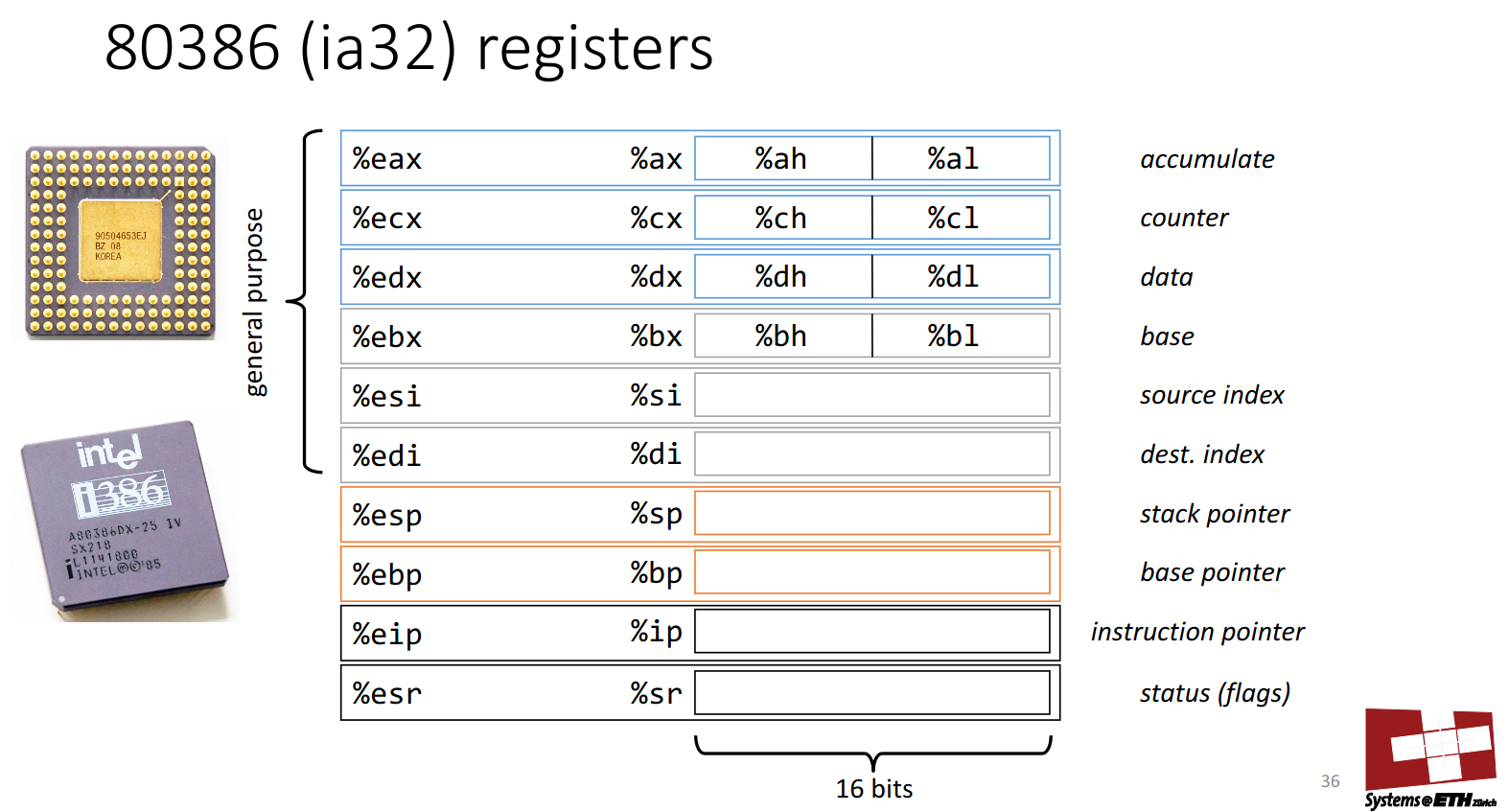
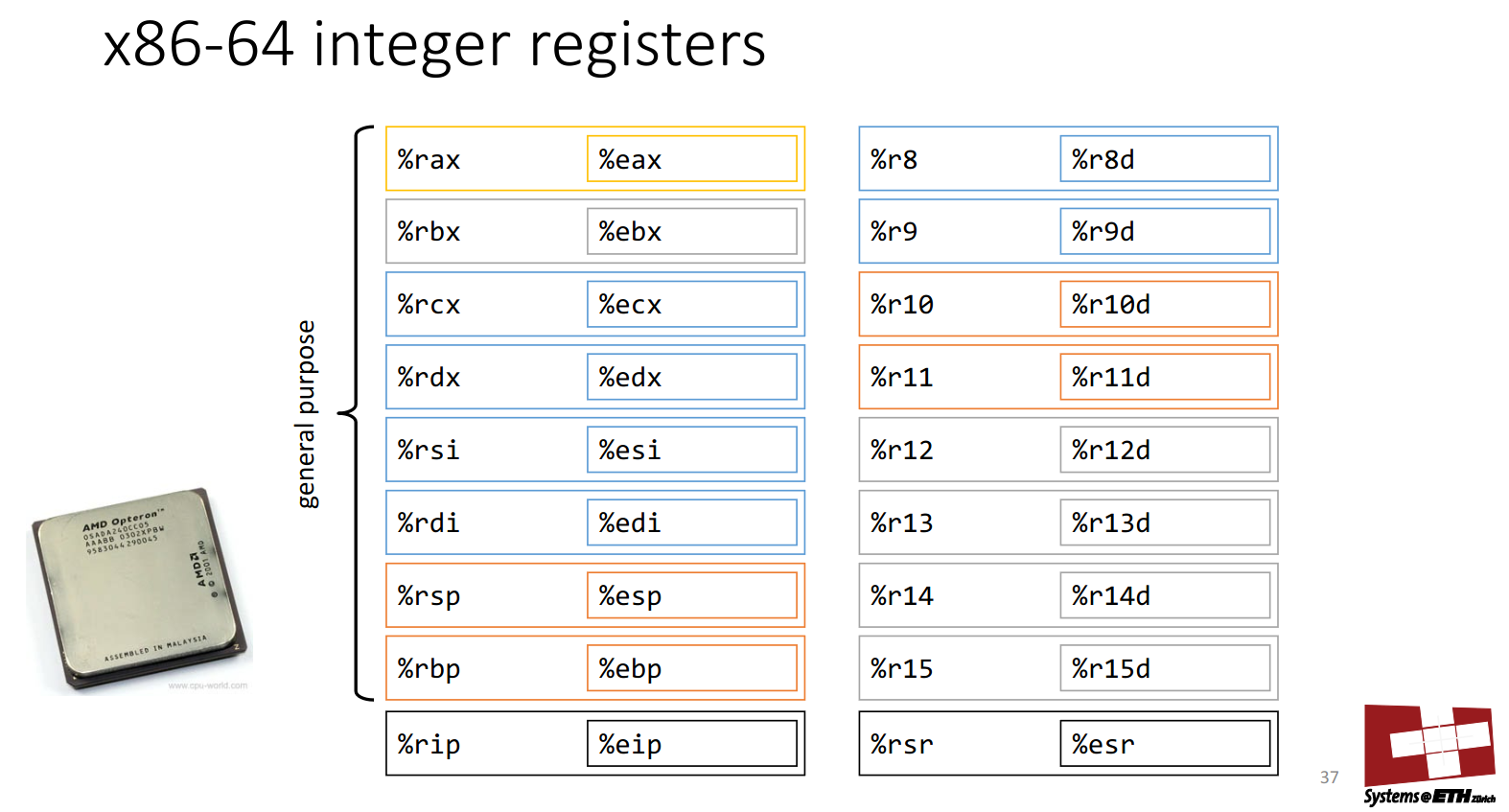
The transition from 32-64 bits again extended, now with the “r”-prefix. It also added some new regs: r8-r15.
Here also, the old names still work!
| 64-bit | 32-bit | 16-bit | 8-bit (low / high) | Role |
|---|---|---|---|---|
%rax | %eax | %ax | %al / %ah | Accumulator: return value; implicit in mul/div |
%rbx | %ebx | %bx | %bl / %bh | Base: general purpose, callee-saved |
%rcx | %ecx | %cx | %cl / %ch | Counter: rep/loop count, shift count in %cl; 4th arg |
%rdx | %edx | %dx | %dl / %dh | Data: high half of mul/div (%rdx:%rax); 3rd arg |
%rsi | %esi | %si | %sil | Source index for string ops; 2nd arg |
%rdi | %edi | %di | %dil | Destination index for string ops; 1st arg |
%rsp | %esp | %sp | %spl | Stack pointer: top of stack (push/pop/call/ret) |
%rbp | %ebp | %bp | %bpl | Base/frame pointer: anchors the stack frame; callee-saved |
%r8–%r15 | %r8d–%r15d | %r8w–%r15w | %r8b–%r15b | Extra general-purpose (x86-64 only); %r8, %r9 = 5th, 6th arg |
%rip | %eip | %ip | — | Instruction pointer: next instruction; only changed by jumps/calls |
rflags | eflags | flags | — | Status flags: CF, ZF, SF, OF, PF (+ DF, IF, TF control bits) |
| Note: rbx sv rbp |
- rbx used to hold the base address of data structures for example, today no special purpose
- rbp → stack frame “base pointer”
6.2 Instructions
byte, word, longword? doubleword?, quadword
AT&T Syntax!
lea instruction for (rds, rdi, k) for k = 1, 2, 4, 8
- we can do mult by 3 with
(rds, rds, 2) = rds + 2*rds
CF → unsigned overflow
OF → signed overflow (a > 0 && b > 0 && t < 0) || (a < 0 && b < 0 && t > 0)
→ TODO: check if this is right
you can set them with test → check explicitly, to check without actually computing
setX instructions → interpret flags into a reg to check some conditions (above, below, equal, etc..)