How do we maximise joint payoff!
we need to structure the contract in order to maximise this (no fixed terms, etc…)
- we insert the clause “only if exerted high effort”
- this is called a contigent contract (payment contigent on)
- contract law → implicit conditions (like implicit guarantee)
first best outcome: what would be achieved if there were no information problems
Contract term increasing size of pie: mutually beneficial contract term
Negotiate:
- how big a pie
- how big a slice?
202. Non-contractable Effort
Hard to describe what “high-effort” looks like
- problem of describability (layperson observing engineer)
- observability (travelling salesperson)
- verifiability (difficult to back up claim that employee is not working hard in court)
We could contract on signal of effort (sales get commission based on sales targets)
Invest in monitoring → easier to track effort
Leveraging reputational concerns → effort observable but not verifiable threatening to end business could be enough
Even if effort is non contractible, you can still achieve first-best outcome when output depends deterministically on effort
- then pay on effort?
But quality of product / state of general economy / market conditions, etc… influence the pay then.
Social Optimum for manager (that might get lucky due to economy)
- socially optimal choice is for the manager to go for high effort → highest joint surplus
- we offer contingent contract
- manager will choose high-effort to maximise payoff
- here participation constraint also satisfied → company has payoff 50
Participation constraint (individual must be willing to sign the contract)
Incentive constraint (agent must want to take the action the principal intends)
Is the contract achieving first best unique? No
- sometimes more than one contract achieves first-best
sell the shop contract
- literally selling the company to the manager
- for example → management buyout!
Risk of failure
- contingent → risk distributed
- sell the shop → risk only on manager
Cannot structure contract so we have all the risk → manager would just slack off.
→ Who controls the risk, must bear the risk
203. Risk-Incentive Tradeoff
If signal is not perfectly correlated to effort → stochastically correlated only
- risk is on the manager (general economy risk, etc…)
Building landowner:
- assign risk of floods/earthquakes to the one who can better bear the risk
- tenants compensate you more than expected damages
- since you’re wealthy, you can bear the risk better
- tenant willing to pay more than E[X] = 10 risk of loosing 100k → billionaire doesn’t care
value can be created by shifting risk from the risk-averse to risk-neutral party
- tenant willing to pay more than E[X] = 10 risk of loosing 100k → billionaire doesn’t care
Risk types:
- risk neutral: pay exactly up to the expected value
- risk averse: pays less than expected value (like fire-insurance)
- risk seeking: lottery ticket buyer (more rare)
Risk Diversification:
- if you have property in different areas and are construction company owner → you lose building + make profit rebuilding
Law of Large numbers: personal risk fluctuates, but over large population risk constant
- insurance company knows what to expect
- diversify on car insurance company and repair company
More risk should be borne by risk-neutral party or party that is better able to diversify risk
Optimal risk sharing generates value!
Apple Manager: we should offer insurance on phone → best positioned to bear the risk
- but user controls the risk here → so more negligent behaviour
- Moral Hazard
incentive vs risk sharing perspectives clash
- when those factors do not point in the same direction → risk/incentive trade-off
- cannot simultaneously achieve first-best risk and incentive provision
Manager is risk-averse → lottery due to contingent contract / sell the shop contract
- but contingent lower risk → so value it higher
Second best contract: although contingent better than “sell the shop” it did not achieve first best (only 80 joint surplus)
- we cannot always eliminate transaction costs completely
- if agent is risk-averse and we can only contract on noisy signal of effort
- cannot achieve first-best
204. Information Content
owner of a truck company → how to incentivise driving well.
- is delivering fast good proxy?
- not perfect, bad traffic, etc…
- but can derive likelihood
- we want fast + goods arrive intact
Optimal incentive scheme:
- look at information content signal
- not at physical properties signal (like qty, quality)
but can get quite complex → non linear, etc…
In order to be valuable information for contract incentives
- cannot be noise, must be signal!
- independent information, not perfectly correlated to another signal
Relative performance evaluation:
- two investment managers → since they both are impacted by macro
- make their pay depend on the other one
- when writing a contract for a risk-averse agent → only make them take as much risk as absolutely necessary
- compare to others in same situations
higher prob of high effort → more comp
lower prob → less comp / punish
205. Robustness / Path Dependence
perfect signal might be possible:
- two students, one studying hard / one no effort
- we observe that if grade < 2.5, the student for sure did not study
- no risk, since if you study can never get below that
- and if punishment high enough, deterrent
- But not working students might fall into pass by luck!
- achieves first best!
- this is a contract called shifting support schemes → high effort student can only get grades between 2.5 - 9
This depends on assumptions → the ranges might be wrong!
- if there’s a probability your range is wrong → might punish high effort a lot!
Investment manager:
- shifting support scheme → if performs worse than -20%, then clawback
- but this is vulnerable to wrong assumptions
- manager might not even accept due to high transaction fees
- We can offer linear compensation structure. This is more robust for wrong assumptions
- resilience of contract! but never perfect
When designing a contract, you should avoid contracts which are too sensitive to your assumptions (except if you have absolute faith).
Bridge example: final damper installation. Takes 5 years, damper only in last year.
- engineering company gets very low flat fee for mediocre, but giant bonus for good dampening
- But step function payoff here is risky:
- if they make bad progress / unlucky → no incentives, since they know no chance of bonus
- intermediate progress → high incentive
- if they already achieved it after 3 years, they will not improve further, so no incentives
strength of incentives is path dependent!
With a linear function, we can incentivise constant effort!
For safety → step function might work, since anything above “safe” is not needed. But sometimes we want them to work as hard as possible → linear for path independence.
206. Monitoring
Rather than contracting on a signal → want to make it observable directly → use monitoring
Salesperson contract: we want contingent contract.
- signal of effort: sales are dependent on outside factors
- exposes risk-averse agents to risk!
- monitoring:
- app to update progress
- bodycam monitoring
Probabilistic monitoring: do not need to monitor 24/7
Police at every corner, 1% of the time, fine them 100x, so in expectation it’s the same → small problem with this.
Bentham’s panopticon (prison observation tower, make them think it’s possibble to be observed at all times)
Issues:
- Criminal offenses: can break wealth constraints using criminal consequences i.e. prison. Private parties cannot.
- Chilling effect: if driving above speed limit = prison, might never drive.
- difficulty to process small probabilities are hard
AI monitoring now possible: but might be ethical / moral dilemma, lost trust!
207. Distortion
We want to contract on high effort.
- assume observing effort = costly
- observing signal of effort = free
Input vs. Output monitoring: factors: cost, risk
- input monitoring = effort
- output monitoring = signal
But signal can be noisy, because there are factors in between input→output
This noise exposes the agent to unnecessary risk!
→ Input monitoring avoids this (observes measures over which the agent has full control).
Another factor = distortion.
Ex: PISA test. US teachers paid on PISA test results.
- more motivated to teach to read
- teaching readings vs. teaching to the test
- might encourage to cheat!
Paper “Rotten apples” → 4-5% of elementary school teachers cheated when paid by examiners.
- gave extra time
- corrected wrong answers in worst case
What you measure is what you get → Test might determine not reading ability but also test taking ability!
→ distortion in test
If you have multiple goals, incentivising for none is better than for both of them
- otherwise agent will prefer the one that is incentivised!
→ High powered incentives are dangerous here.
More downstream measures are less distorted:
ex: students → measure QoL after school
- less distorted → this is exactly what we want!
- but this is very noisy!
Mechanics paid on % of repairs → leads to unnecessary repairs!
Windshield installer: get paid for installed, but has to fix broken ones without any pay.
- this works well since it incentivises good install as well.
208. Limited Wealth
Incentive-Rent Extraction Tradeoff:
- low commission → more profits per sale but sales down
- using all your bargaining power to squeeze your distributor can distort incentives
- high commission → will sell more, but give up some profits
⇒ Give good incentives to partner ←> want to get money yourself.
Can we avoid the tradeoff?
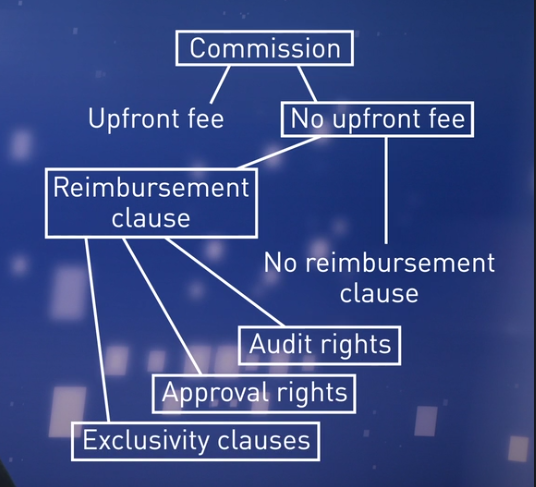
- upfront fee: extract as high a rent as we want, while keeping incentives at a maximum
- 100 commission, but $500M up-front fee
- in the extreme → make distributor buy the game from us (keep all profits)
- effectively sell the shop contract.
- not optimal if risk-averse
But the distribution-partner = small shop = risk-averse:
- Sell the shop is all risk on him
even if he’s risk-neutral → if he doesn’t have the money, no deal.
If there are limits to the upfront-free → use commission to give incentive and extract rent = trade-off.
⇒ We cannot always work around risk-incentive tradeoff due to limited wealth.
- before it was risk-averseness.
→ First best impossible.
How to get first best?
- monitor distribution partner directly (monitor effort directly)
- might be impossible
- exclusivity clause. if the distributor works for another producer as well
- will choose the game with higher commission
- avoid this with exclusivity clause!
But even with exclusivity → he won’t spend 20 of commission.
But if we reimburse all costs → overspending!
- removes expenses to stay lean
- inflates them / kickback
→ might reserve rights to audit his contracts / reimburse part
Have to avoid excessive outsourcing (inflation of costs if reimbursed)
- clearly define the stuff than can be outsourced in contract.
Bandaging contracts like this with extra clauses, etc… leads to fixing each hole.
209. Asymmetric
You are manager with 10% of firm profit.
Investment:
- 50% * 100 + 50% * 0 = 50
- thus you invest. Personal profit is 5.
- 50% * 200 + 50% * -300 = -50
- for you personally though, you get 10 payoff!
- since you don’t have to bear potential losses
If you have to choose → you will choose project 2! Bad for company, good for you.
Problem: incentive regime is asymmetric! (agent discounts downside risk)
Make incentives symmetric! → add clawback provision with managers (get back bonus if loss occurs).
→ even if you do make it symmetric, might remain de-facto asymmetric.
If agent cannot pay beyond a certain point → loss = 0. Agent declares bankruptcy and walks away.
Gambling for resurrection → losing money increases net-debt, but creditors get everything anyway → nothing more to lose.
If low downside-risk → symmetric for even low-asset agent.
If high downside-risk → Deep pocketed agent has symmetry, low-asset is not.
You can screen potential subcontractor balance sheets → disqualify them.
- but not always possible
- expertise but not wealth is possible (talented manager, small firm highly qualified)
You will have to contract differently for them.
For low asset agent:
- not too high-powered incentives.
- reduce share from 10% to 1%, then share in losses is also smaller.
- but this also reduces the incentives.
- have to decide between downside risk management vs. not working hard enough.
- Tighter risk-management for low asset agents
- require approval for projects with high downside risk
- will have to monitor compliance
- higher monitoring cost!
- might need to forego very profitable high-risk projects
- require approval for projects with high downside risk
Dynamic strategy → tighten reins as agent becomes financially distressed
- creditors get more robust role as the debt rises.
Understand additional incentives that arise outside of the incentive scheme:
- getting fired is such high risk for high-profile manager
- no need for symmetric incentive schemes
→ manager might even be too cautious → play it safe.
asymmetry can be in the other way too!
- no need for symmetric incentive schemes